
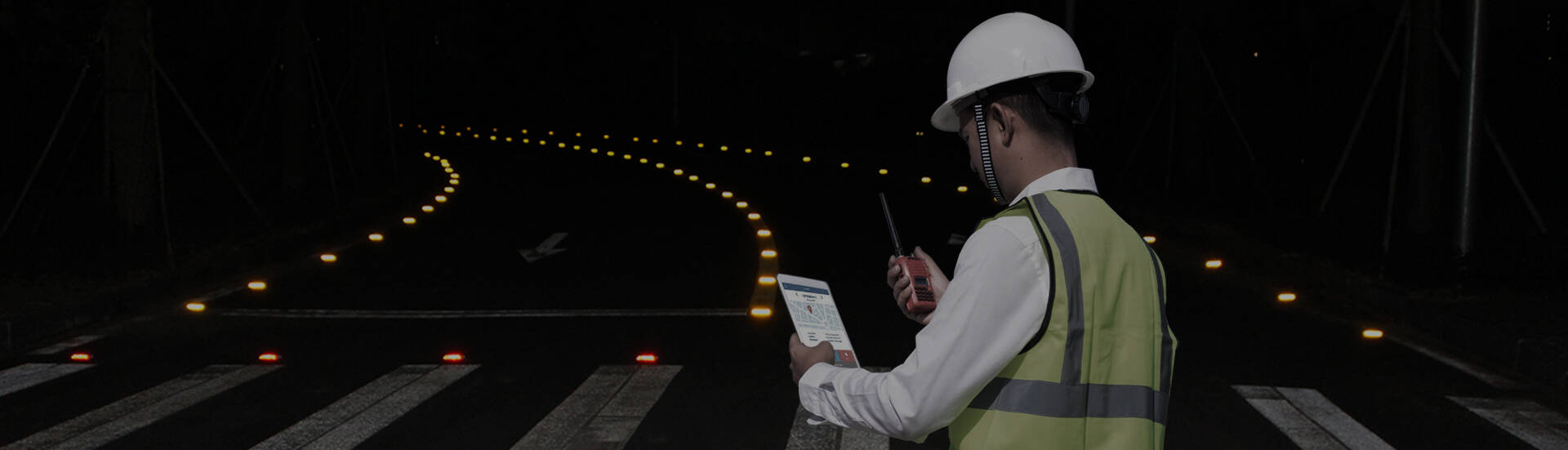
As a core active lighting solution for low-visibility environments, solar road studs—which store energy during the day and emit light at night—are widely used on highways, urban roads, parking lots, and emergency construction sites, serving as a key piece of equipment for enhancing road safety. However, many engineering procurement professionals and road maintenance personnel face the same dilemma when selecting models: Which is better—pole-mounted (with stud feet) solar road studs or pole-less (flat-bottomed) solar road studs?
Choosing the wrong type not only leads to stud detachment, breakage, water leakage, and a shortened lifespan, but also increases long-term maintenance costs. In critical scenarios such as high-speed, heavy-load traffic or emergency construction sites, it may even pose safety hazards. The core difference between pole-mounted and pole-less solar road studs lies not in “good or bad,” but in “suitability”—only by matching the application to the specific scenario, traffic flow, and road surface conditions can their full value be realized. This article will conduct an in-depth comparison of the two types across six key dimensions to debunk common selection misconceptions. Drawing on HOAN Traffic’s (haroadstud.com) 15 years of industry experience and comprehensive product portfolio, we provide precise selection guidance while highlighting the professional advantages of HOAN’s pole-mounted and pole-less solar road studs, helping to enhance road safety and project cost-effectiveness.
HOAN Traffic has dedicated 15 years to the R&D and production of solar road studs, having undergone five generations of product iterations. We offer a comprehensive product lineup that includes both pole-mounted (e.g., G105 model) and pole-less (e.g., IL300 model) variants, precisely tailored to diverse global road conditions and project requirements. Through rigorous quality control and core technologies, we have become the preferred partner for numerous large-scale road projects.
The core difference between solar road studs with and without shanks lies in their base mounting structure, which directly determines their installation methods, mounting strength, and suitable applications. You can quickly distinguish between them without needing complex technical knowledge.
Solar road studs with shanks, also known as studs with mounting legs, feature a 50–60 mm long metal or plastic shank at the base. The main body consists of a base and a cover, which are assembled and secured with screws. Their core design principle is “embedded fixation,” relying on the shank to penetrate the road surface. Combined with adhesive bonding and screws, this achieves dual fixation, enhancing tensile resistance. The HOAN G105 cast aluminum solar road stud with shank is a representative product. It features a one-piece cast aluminum base and a reinforced metal shank, offering a compressive strength of over 30 tons and IP68 waterproofing, making it suitable for high-speed, heavy-load applications.
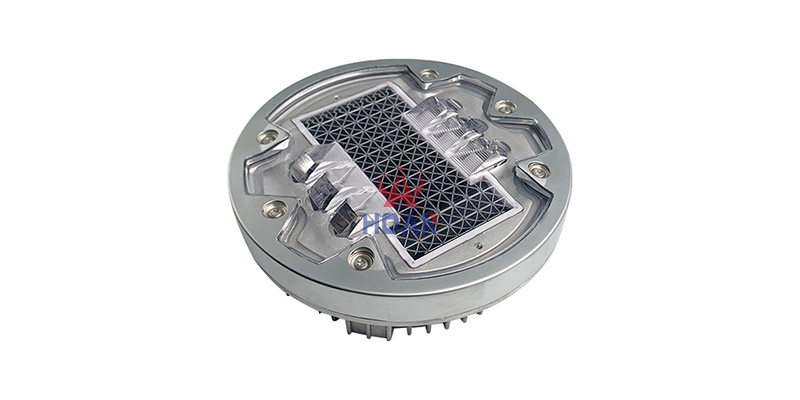
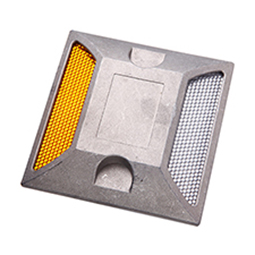
Shankless solar road studs feature a flat-bottomed, one-piece design with a smooth base and no protruding shank. No drilling is required; they are directly adhered to the road surface using specialized adhesive. The core design principle is “surface contact fixation,” which relies on extensive contact between the base and the road surface to enhance shear resistance. The HOAN IL300 Shankless Ultra-Thin Solar Road Stud is a representative product, measuring only 25 mm in thickness. It is manufactured through integrated die-casting with no seams, making it suitable for thin pavement surfaces, temporary emergency installations, and other scenarios, ensuring convenient and efficient installation.
Pole-mounted solar road studs: Dual fixation via drilling and adhesive bonding; rely on the pole embedded in the road surface to resist tensile forces; suitable for long-term heavy-duty traffic. Pole-less solar road studs: Fully bonded to the road surface via the base; rely on contact area to resist shear forces; suitable for rapid deployment and scenarios requiring no road surface damage. There is no absolute superiority between the two; only differences in suitability for specific scenarios.
To help you make a more precise selection, we conduct an in-depth comparison of pole-mounted and pole-less solar road studs across six core dimensions: installation difficulty, compression resistance and durability, waterproof performance, cost, applicable scenarios, and service life. Combining these with the advantages of HOAN products, we break down every key selection factor.
The installation process for pole-mounted solar road studs is complex, involving five steps: “drilling (25mm diameter/55mm depth) → cleaning the hole → injecting adhesive → inserting the pole → curing.” Installing a single unit takes 15–20 minutes and requires specialized drilling equipment, resulting in low construction efficiency. This makes them suitable for long-term projects and scenarios with advance planning.
The installation of pole-less solar road studs is extremely convenient, requiring only four steps: “clean the road surface → apply specialized quick-drying adhesive → press to secure → cure.” No drilling is required, and installation of a single unit takes only 5 minutes. No specialized equipment is needed, making it easy for even beginners to operate. This makes them particularly suitable for emergency construction, temporary traffic control, and other scenarios requiring rapid deployment.
To address the installation complexity of the pole-mounted model, HOAN provides a dedicated drilling jig to precisely control hole dimensions, along with detailed installation video tutorials and a toolkit. The pole-less model uses high-strength epoxy quick-drying adhesive, reducing curing time to 30 minutes and significantly improving installation efficiency.
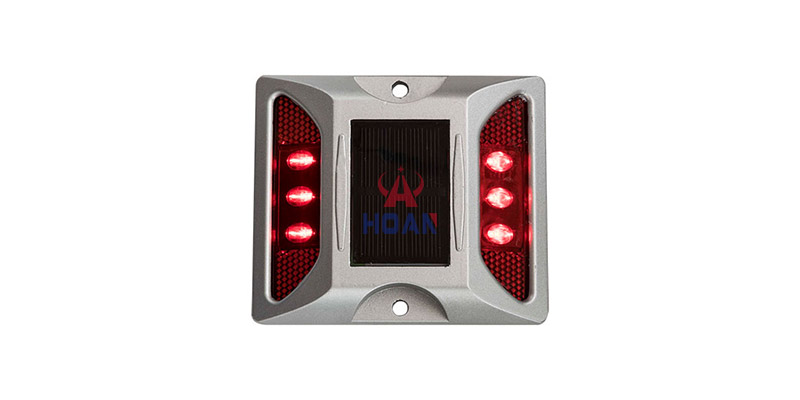
Compressive strength and durability are core performance metrics for solar road studs, directly determining their service life and safety. Pole-mounted solar road studs have their poles embedded in the concrete pavement, providing strong tensile resistance and effectively withstanding the upward pulling force caused by heavy-duty vehicles, making them suitable for sections with high concentrations of heavy traffic; however, their weakness lies in the screw connections, which are prone to loosening due to long-term vehicle vibrations, potentially causing the stud to separate vertically. Among these, the cast aluminum pole-type model can withstand compressive loads of over 30 tons, while the plastic pole-type model can withstand approximately 15 tons, catering to different traffic flow requirements.
Pole-less solar road studs feature an integrated die-cast structure with no screw joints, eliminating the risk of loosening. They offer strong shear resistance and are unlikely to break; however, their weakness lies in the mounting method—if the adhesive layer deteriorates, the entire unit may detach. HOAN’s rodless cast aluminum model can withstand pressures of up to 30 tons, making it fully suitable for standard traffic scenarios such as urban arterial road curbs. Only in high-load core areas, such as highway medians, should the rod-type model be prioritized.
To address industry pain points, HOAN’s rod-type model uses anti-loosening stainless steel screws combined with dual sealing gaskets to completely resolve the issue of screw loosening; The base of the rodless model features a honeycomb anti-slip design, paired with specialized epoxy adhesive, which significantly enhances bonding strength, prevents detachment, and offers durability far exceeding the industry average.
Solar road studs are exposed to the outdoors for extended periods. Water and moisture infiltration can directly damage internal circuits, causing the studs to fail; therefore, waterproofing is critical. For pole-mounted solar road studs, the primary risk points for water ingress are the joints between the pole and the base, as well as the screw holes in the top and bottom covers; if the sealing process is inadequate, water can easily penetrate.
Pole-less solar road studs utilize an integrated die-cast design with no seams or joints, offering inherently reliable waterproofing that is particularly suitable for rainy and humid regions. However, HOAN has not overlooked the waterproofing shortcomings of the pole-mounted models. All pole-mounted solar road studs feature an additional bottom resin-sealing process, paired with IP68-rated waterproof O-rings. These have undergone rigorous immersion testing to eliminate water ingress and ensure stable operation even in extreme rainy conditions.
A cost comparison must consider three dimensions—purchase, installation, and maintenance—to reflect true value for money. Pole-mounted solar road studs have a relatively higher purchase price; taking the HOAN G105 cast aluminum pole-mounted model as an example, the purchase price is approximately $14–$16 per unit. Additionally, costs for drilling equipment and labor must be accounted for, and periodic tightening of screws is required later on, resulting in higher overall costs.
Pole-less solar road studs have a moderate purchase price; for example, the HOAN IL300 ultra-thin pole-less model costs approximately $12–$15 per unit. They require no drilling equipment, have low installation labor costs, and require only surface dust cleaning for maintenance—no additional investment is needed. Their total cost is over 30% lower than that of pole-mounted models, making them suitable for projects with limited budgets and standard applications.
The core of product selection is “scenario compatibility.” By considering traffic flow, road surface conditions, and construction requirements, you can avoid waste and product failure:
Pole-mounted solar road studs are better suited for: highway centerlines, heavy-duty lanes on national highways, bridges, tunnel entrances, and similar scenarios. In these environments, where heavy vehicles pass over them continuously, strong tensile resistance is required. The dual-fixation method of pole-mounted models ensures long-term stability and prevents them from being dislodged by heavy vehicles.
Pole-less solar road studs are more suitable for: urban road edges, parking lots, bicycle lanes, emergency construction sites, temporary traffic control zones, and thin pavement surfaces. In these scenarios, traffic flow is relatively light, drilling to damage the pavement is unnecessary, and rapid deployment is required. The pole-less models offer greater convenience and cost-effectiveness.
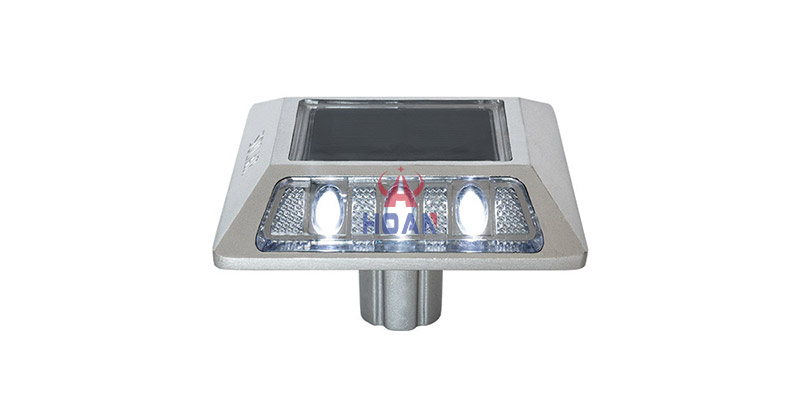
Pole-mounted solar road studs have a service life of approximately 3–5 years. The primary causes of failure are loose screws and water leakage at the joints. With proper maintenance—such as regular inspections and tightening of screws—their lifespan can be extended. Pole-less solar road studs feature a more stable, integrated structure with a service life of approximately 5–7 years. Even if the adhesive layer deteriorates, they can be reapplied with new adhesive for reuse, making them more hassle-free for long-term use.
Based on HOAN Traffic’s 15 years of industry experience, we have identified four common pitfalls that many users encounter during selection and use. These not only affect the service life of the road studs but may also increase costs and create safety hazards. Only by accurately avoiding these pitfalls can solar road studs deliver their maximum value.
Many users believe that pole-mounted models, with their fixed poles, are inherently more durable than pole-less models. This is not necessarily true. While pole-mounted models offer high tensile strength, the screw connections are prone to loosening and water leakage. If sealing and maintenance are inadequate, they may actually fail more easily than pole-less models. Pole-less models, with their integrated structure, eliminate the risk of loosening. As long as high-quality adhesive and waterproofing products (such as HOAN IL300) are selected, their service life can actually be longer. The correct approach is: choose pole-mounted models for heavy-duty applications, and pole-less models for standard or emergency scenarios. HOAN can provide customized selection solutions based on road conditions and traffic volume.
This is one of the most common misconceptions. Many users believe that pole-less models, which rely on adhesive bonding, have poor compression resistance and can only be used in parking lots or on bicycle lanes. In reality, HOAN’s pole-less cast aluminum solar road studs have a compressive strength of over 30 tons, making them fully capable of withstanding normal traffic on urban main roads. Only in high-load core areas, such as highway medians, should pole-mounted models be prioritized to avoid over- or under-specification.
Some users, in an effort to save installation time, blindly choose the postless model for highways and heavy-duty lanes, resulting in road studs being lifted or dislodged by heavy vehicles, which actually increases maintenance costs. It must be made clear: for scenarios such as highway medians and heavy-duty lanes, the post-mounted model must be selected for drill-hole installation. The postless model cannot withstand the tensile force of heavy vehicles and is highly prone to failure over the long term; Although pole-mounted models are more complicated to install, they ensure long-term stability and are the only reliable solution for heavy-duty applications.
Many users focus solely on price during procurement and choose low-cost products without IP68 water resistance. Once rainwater penetrates these road studs, the internal circuitry burns out within 1–2 months, causing failure and ultimately increasing both procurement and maintenance costs. The correct approach is: Regardless of whether you choose pole-mounted or pole-less models, ensure they meet the IP68 waterproof rating. HOAN’s entire series of solar road studs has passed IP68 waterproof testing and international certification, ensuring stable operation even in extreme rain and humid environments, thereby preventing premature failure.
HOAN Traffic (haroadstud.com) has specialized in the solar road stud industry for 15 years. With a deep understanding of the challenges in selecting products for different scenarios, we have developed a comprehensive product portfolio featuring both pole-mounted and pole-less models. Leveraging core technologies, rigorous quality control, and one-stop services, we provide reliable solutions for global road projects. Whether for heavy-duty, standard, or emergency scenarios, you can find the perfect product to meet your needs.
HOAN’s pole-mounted and pole-less solar road studs cover a range of materials and performance specifications, precisely tailored to various scenarios:
Pole-Mounted Series (Preferred for Heavy-Duty Applications): The HOAN G105 cast aluminum pole-mounted solar road stud features a one-piece cast aluminum base and a reinforced metal pole, with a compression resistance of over 40 tons. IP68 waterproof rating, high-brightness LED light source, nighttime visibility up to 800 meters, suitable for core applications such as highway and national highway centerlines and heavy-duty lanes; withstands long-term rolling from heavy vehicles, ensuring stability and durability.
Pole-less Series (Ideal for Standard/Emergency Use): HOAN IL300 Pole-less Ultra-Thin Solar Road Stud, 25mm thick, one-piece die-cast construction, 30-ton load capacity, quick adhesive installation, suitable for urban roads, parking lots, emergency construction sites, and other scenarios; HOAN Ceramic Pole-less Road Stud, made of high-density ceramic material, heat-resistant, fade-resistant, and anti-aging, suitable for extreme environments such as the rainy south and high-temperature northwest regions, with a service life exceeding 7 years.
To help users quickly select the right product, HOAN provides precise recommendations based on specific application scenarios, directly matching products with project requirements: 1. Highways and heavy-duty lanes → HOAN G105 Cast Aluminum Road Studs with Posts (compressive strength >40 tons, high tensile strength, long-term stability); 2. Urban roads, parking lots, emergency construction sites → HOAN IL300 Pole-less Ultra-Thin Road Studs (quick installation, cost-effective, no road surface damage); 3. Regions with extreme heat and heavy rainfall → HOAN Ceramic Pole-less Road Studs (durable and resistant to aging, low maintenance costs, suitable for harsh environments).
There is no absolute superiority between pole-mounted and pole-less solar road studs; the key lies in “scenario suitability”—select pole-mounted for heavy-load and high-tensile-strength requirements, and pole-less for standard applications and rapid deployment. By avoiding common selection pitfalls and considering traffic volume, road surface conditions, and budget, you can balance durability, cost, and installation efficiency, ensuring road safety while reducing long-term maintenance costs.
With 15 years of deep expertise in road safety, HOAN Traffic leverages professional R&D capabilities, rigorous quality control systems, and a comprehensive product portfolio to provide full-scenario solutions featuring both pole-mounted and pole-less solar road studs for global road projects. Whether for high-speed heavy-duty applications, urban standard use, emergency construction, or extreme environments, HOAN offers tailored products and one-on-one selection guidance. Choose HOAN solar road studs (haroadstud.com) for hassle-free selection and worry-free use. Let our professional quality safeguard every journey. Contact HOAN to request a free selection plan, product quotes, and sample requests.
.png)