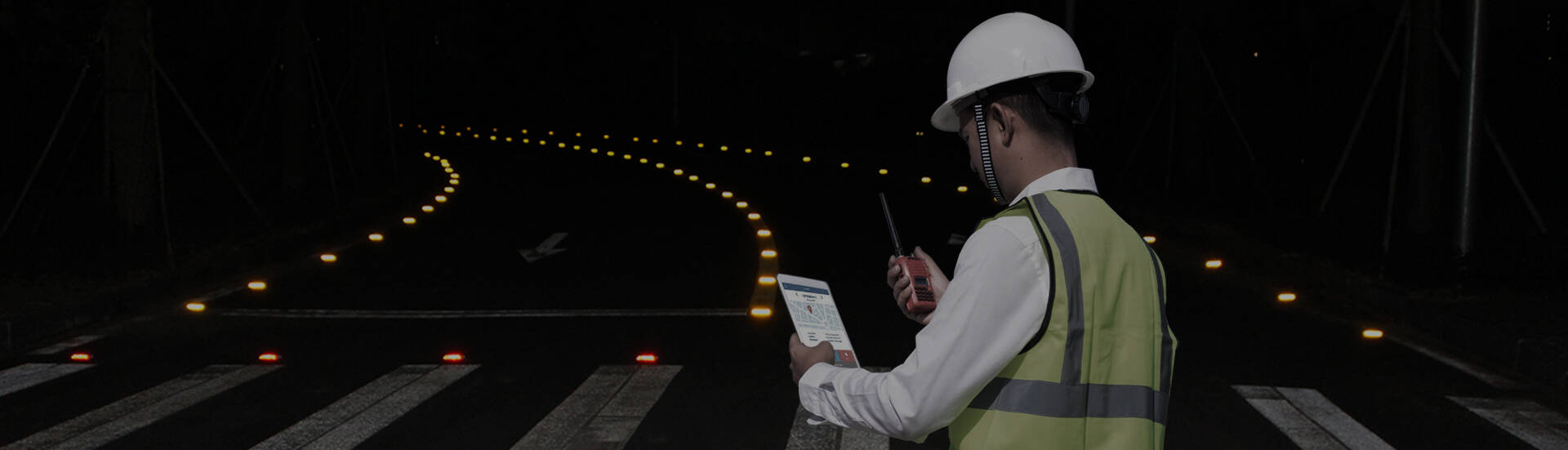
Highways, with their high traffic speeds, high concentration of heavy-duty vehicles, and continuous traffic flow, are among the scenarios with the highest risk of accidents in the road traffic system. In particular, mountain highways, foggy sections, long downhill slopes, interchange ramps, and tunnel entrances and exits are plagued year-round by poor visibility, insufficient reaction distances, and low road condition discernibility. Traditional thermoplastic road markings and standard reflective road studs rely heavily on vehicle headlights; their warning effectiveness is significantly reduced in rainy nights, dense fog, and pitch-black conditions, making them highly prone to causing major traffic accidents such as lane departures, rear-end collisions, rollovers, and vehicles crashing through guardrails.
At the same time, installing municipal lighting along the entire length of an expressway is extremely costly and difficult to maintain, leaving most rural and remote expressway sections without lighting for extended periods, resulting in significant gaps in road safety protection. In expressway renovation, expansion, and maintenance projects, solar-powered road studs have become the core equipment for replacing traditional road markings and addressing safety deficiencies on high-risk sections. HOAN Traffic has deepened its expertise in the field of highway safety, specializing in the research, development, and production of heavy-duty solar road studs designed specifically for highways and adapted to various complex highway conditions. This article will provide an in-depth analysis of the core principles, key application scenarios, product advantages, and engineering selection criteria for solar road studs in enhancing highway safety, offering professional, practical guidance for highway engineering contractors, highway administration procurement teams, and road operation and maintenance teams.
The unique nature of expressway traffic inherently creates numerous road safety vulnerabilities, which are also the primary causes of frequent traffic accidents. First, due to high speeds on expressways, drivers have extremely limited reaction times. Any misjudgment of lanes or failure to anticipate road conditions in a timely manner can easily trigger chain-reaction accidents, and the margin for error is far lower than on ordinary urban roads. Second, most remote and mountainous expressways lack continuous street lighting. Nighttime driving relies solely on a vehicle’s headlights, making lane outlines indistinct at a distance and creating significant visual blind spots.
Traditional road warning facilities suffer from obvious performance deficiencies. Thermoplastic markings, subjected to long-term rolling by heavy-duty trucks, rain erosion, and intense UV exposure, are highly prone to fading, peeling, and wear, ultimately losing their basic guidance function; Ordinary passive reflective road studs rely entirely on reflection from vehicle headlights; during heavy rain, dense fog, or sandstorms, their reflective effect becomes virtually ineffective, rendering them incapable of serving as a warning. Meanwhile, installing streetlights along the entire route requires extensive wiring and construction, resulting in high construction costs, cumbersome post-construction maintenance, and massive energy consumption—making it unsuitable for widespread adoption across long-distance highway networks.
Furthermore, high-risk sections of expressways feature complex driving conditions—including curves, long downhill slopes, tunnel entrances and exits, and interchanges with intersecting traffic and fluctuating speeds—where traditional markings cannot provide targeted, enhanced warnings. Today, road administration standards in most countries worldwide are continuously being upgraded, requiring high-visibility, all-weather, and stable active-lighting warning devices on expressway sections with high accident rates. Traditional road markings can no longer meet the safety requirements of modern expressway construction.
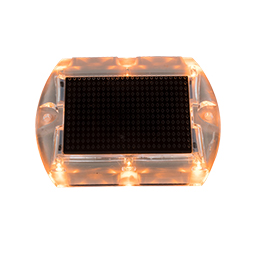
Unlike traditional passive reflective markers, solar road studs leverage the core advantages of autonomous energy storage and active illumination. They comprehensively address highway safety challenges across four dimensions—visibility, guidance, environmental adaptability, and operational durability—significantly reducing the incidence of highway accidents. As such, they are essential equipment for upgrading highway safety.
Traditional reflective road studs can only passively reflect vehicle headlights and become completely ineffective in the absence of vehicle lighting or during severe weather conditions. In contrast, HOAN’s solar-powered road studs, specifically designed for highways, can store energy independently and emit a bright, active light without relying on any external light source. Even in low-visibility conditions—such as late at night, during heavy rain, in dense fog, or in sandstorms—they maintain a clear and bright warning effect. Their effective visibility range far exceeds that of traditional markers, providing drivers with ample reaction time to slow down, swerve, or change lanes, thereby eliminating the risks of rear-end collisions and lane departures at their source.
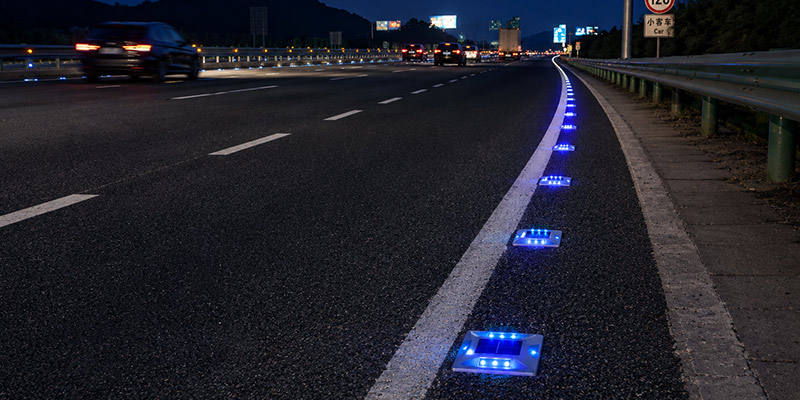
Driving on highways for extended periods can easily lead to visual fatigue, which in turn can cause drivers to drift out of their lanes. When solar road studs are installed at standard intervals, they form a continuous, uniform strip of light on the road surface that clearly delineates lane edges, median strips, and road contours. This continuously corrects drivers’ driving trajectories, alleviates visual fatigue, effectively reduces traffic accidents caused by drowsy driving and inattention, and ensures orderly traffic flow.
HOAN solar road studs support multiple lighting modes, including constant-on, slow flashing, fast flashing, and alternating strobe, allowing for customized warning effects tailored to different high-risk sections of expressways. In hazardous areas such as curves, long downhill slopes, and tunnel entrances, the high-frequency strobe mode can be activated to enhance visual alerts, prompting drivers to slow down and proceed with caution well in advance, precisely marking road condition risks, and significantly improving safety on high-risk sections.
Highway sections experience frequent traffic from heavy-duty trucks, significant road wear and tear, and complex climatic conditions. HOAN’s highway-specific solar road studs feature a one-piece cast aluminum body with exceptional compressive strength, capable of withstanding repeated rolling by heavy-duty vehicles without cracking or detaching. Combined with IP68 fully sealed waterproof and dustproof technology, they can withstand prolonged exposure to rain, snow, high temperatures, and freezing conditions, ensuring stable all-weather operation without safety gaps caused by lighting failures or equipment malfunctions. They are ideally suited for the long-term, high-intensity operational conditions of highways.
Based on the distribution of risks associated with expressway conditions, solar road studs are primarily suited for high-risk sections where accidents frequently occur and traditional signage has failed. They specifically address safety gaps on expressways and are suitable for various new construction, renovation, expansion, and maintenance upgrade projects.
Continuous curves and long downhill sections on mountainous highways feature high speeds and obstructed visibility, making them prime locations for accidents such as speeding-induced skidding and vehicles veering out of their lanes—these are core high-risk points on highways. Traditional markings fail to clearly indicate changes in road curvature and gradient. However, when HOAN cast aluminum solar road studs are densely installed, they clearly outline the contours of curves and slopes. Through dynamic flashing, they alert drivers to slow down in advance, enabling them to accurately anticipate road conditions and avoid driving risks.
At highway interchanges and on ramps, traffic flows frequently intermingle, and vehicles frequently change lanes and accelerate or decelerate, making these areas highly prone to scrapes and collisions. Dual-sided solar-powered road studs clearly demarcate ramp boundaries and traffic diversion zones, clearly define the boundaries between the main roadway and ramps, guide traffic to merge and diverge in an orderly manner, standardize traffic flow, and reduce the risk of traffic conflicts.
Mountainous highways are frequently shrouded in fog year-round, with extremely low visibility, making them high-risk areas for highway accidents. Traditional reflective road markings and reflective road studs are virtually ineffective in foggy conditions. Solar-powered active-emitting road studs feature extremely strong light penetration, clearly displaying lane directions and road boundaries even in dense fog. They provide essential guidance for vehicles and help prevent large-scale chain-reaction accidents.
The extreme contrast in light levels between the inside and outside of tunnels causes temporary visual glare and delayed visual adaptation as vehicles enter or exit, which can easily lead to sudden accidents. Solar-powered road studs bridge the gap between road markings inside and outside the tunnel, forming a continuous luminous guide line that minimizes the visual disruption caused by the change in light, ensuring vehicles can enter and exit the tunnel safely.
Emergency lanes are vital lifelines on highways; their unauthorized use is strictly prohibited. Medians prevent vehicles from illegally crossing and interfering with oncoming traffic. High-visibility solar road studs clearly demarcate the boundaries of emergency lanes and medians, serving as a strong warning to reduce dangerous behaviors such as illegal lane occupation and crossing lane lines.
In expressway engineering applications, the two types of road studs are suited for different scenarios. When considering both safety and long-term durability, solar road studs offer significant advantages. In terms of visibility, traditional reflective road studs rely on vehicle headlights and become virtually ineffective in rain, fog, or darkness; solar road studs actively emit light, providing all-weather visibility and superior penetration. In terms of suitability for operating conditions, ordinary plastic reflective road studs have poor compression resistance and are easily crushed by heavy vehicles; HOAN’s cast aluminum solar-powered road studs offer heavy-load compression resistance and strong weather resistance, making them suitable for high-speed, high-intensity traffic.
In terms of construction and operation and maintenance, wiring for grid-powered streetlights involves high costs and complex installation, while ordinary reflective road studs require frequent replacement and maintenance; solar road studs require no wiring, consume zero energy, and have a long service life, significantly reducing construction and O&M costs for long-distance highway networks. In terms of full-lifecycle cost-effectiveness, reflective road studs have a low initial purchase price but require frequent replacement; solar road studs, once installed, operate reliably for many years, better meeting the needs of long-term, safe highway operations.

Product selection for expressway projects must strictly adhere to engineering standards, prioritizing heavy-duty cast aluminum materials to ensure compression resistance and withstand the impact of heavy traffic. Products must meet the IP68 fully sealed protection rating to withstand rain immersion and dust erosion, making them suitable for all-weather outdoor conditions. Regarding installation, standard spacing should be used on straight highway sections, while high-risk areas such as curves, ramps, and fog zones require denser placement to enhance warning effectiveness. In regions with frequent rain and fog, it is essential to thoroughly verify the product’s battery life during overcast and rainy conditions to prevent lights from failing during extreme weather. For overseas highway projects, confirm CE and RoHS compliance; request samples for testing in advance to ensure the project is implemented in compliance with regulations.
Many highway projects encounter issues later on—such as equipment failure, damage, or failure to pass acceptance inspections—all stemming from procurement mistakes. Never use lightweight plastic road studs on main highway lanes, as they are highly susceptible to being crushed by heavy vehicles; avoid products with low protection ratings, as devices rated IP65 or lower are prone to water ingress and short circuits, making them unsuitable for rainy highway conditions; Do not install the same type of equipment along the entire route; on straight sections, economical reflective road studs can be used to control costs, while high-risk sections must be upgraded to solar-powered road studs; at the same time, do not overlook regional sunlight and climate conditions—areas with low sunlight and frequent rain require energy storage configurations with extended battery life.
With their core advantages of active illumination, all-weather visibility, heavy-duty durability, and low O&M requirements, solar road studs perfectly address industry pain points such as poor visibility warnings on highways, the frequent failure of traditional signage, and high risks on hazardous sections. They are essential equipment for modern highway safety upgrades and road network maintenance optimization. From curves and ramps to fog-prone sections, tunnel entrances and exits, and emergency lanes, solar road studs provide comprehensive coverage of high-risk scenarios on expressways, effectively reducing the incidence of lane departures and rear-end collisions while enhancing overall road network safety.
HOAN Traffic’s highway-specific solar road studs feature a heavy-duty cast aluminum body, top-tier IP68 protection, and intelligent multi-mode illumination. They are suitable for all types of new highway construction and maintenance projects worldwide, combining compliance, stability, and cost-effectiveness. For detailed product specifications, highway project deployment plans, and bulk purchase quotes, visit the HOAN Traffic official website at haroadstud.com to request free samples and receive one-on-one consultation on customized engineering solutions.