How Long Do Solar Road Studs Last? Real-World Lifespan and Selection & Maintenance Guide In road lighting, highway renovation, municipal infrastructure, and rural road upgrade projects, solar road studs have become the mainstream road warning devices replacing traditional reflective road studs, thanks to their core advantages of no wiring, zero energy consumption, self-illuminating capabilities, and easy installation. For project procurers, road general contractors, and operations and maintenance service providers, product service life is a key procurement consideration that directly determines the project’s overall cost, the frequency of future maintenance, and the outcome of project acceptance.
Many buyers share the same question: How long is the actual service life of solar road studs? While most manufacturers on the market claim a product lifespan of 8–10 years, in actual field projects, many low-cost products experience issues such as light decay, water ingress, housing damage, and failure to illuminate within just 1–3 years. This traps many projects in a vicious cycle of “low-cost procurement, frequent replacements, and soaring total costs.” This article will thoroughly examine the discrepancy between the laboratory-rated lifespan of solar road studs and their actual lifespan under real-world road conditions, analyze the core factors affecting product lifespan, and provide lifespan reference standards and product selection and maintenance solutions tailored to different road scenarios. Drawing on HOAN Traffic’s professional-grade, long-life solar road stud products, we will help major projects avoid the pitfalls of short-lived products and reduce full-lifecycle O&M costs.
The vast majority of customers tend to fall into a common procurement trap: equating the manufacturer’s laboratory-rated lifespan with the actual service life on the road. In fact, the theoretical lifespan of a solar road stud’s LED chips can exceed 50,000 hours, which under normal use can meet lighting requirements for over ten years; however, in real-world road conditions, the LED chips are rarely the first components to fail. The core components that truly determine the actual service life of solar road studs are the battery, the sealing structure, and the housing material—not the LED chips themselves.
Solar road studs with different configurations and manufacturing processes can vary significantly in actual service life. Low-end products featuring plastic housings and standard lithium-ion batteries are only suitable for urban roads with light traffic, with an actual service life of just 1–3 years; Mid-range products with standard configurations, suitable for ordinary municipal roads, have a service life of 3–5 years; whereas the high-end engineering-grade solar road studs promoted by HOAN Traffic—featuring cast aluminum housings and lithium iron phosphate batteries—are designed for harsh environments such as highways, coastal areas, and mining sites, with a proven service life in real-world projects of 5–8 years—more than twice that of ordinary products on the market.
It is important to note that road conditions directly impact a product’s service life. Harsh environments—such as frequent rolling by heavy-duty trucks, salt fog corrosion in coastal areas, sand and dust erosion in mining regions, and extreme temperature fluctuations—all accelerate equipment aging and damage. Only high-specification, high-quality engineering-grade products can ensure long-term, stable performance.
To select long-lasting solar road studs, there is no need to blindly trust manufacturer claims. Simply verify the five core hardware and manufacturing specifications to accurately assess a product’s durability and avoid short-lived products from the outset.
The battery is the core component prone to wear and tear in solar road studs and the primary factor affecting their service life. Products on the market are mainly divided into two categories: standard lithium batteries and lithium iron phosphate (LiFePO₄) batteries. Standard lithium batteries have a charge-discharge cycle count of only 500–800 cycles and poor temperature resistance. They are highly susceptible to degradation and aging when exposed to high temperatures or rainy conditions over the long term. After about three years of use, they often suffer from insufficient power storage and fail to illuminate at night; this configuration is commonly found in low-end products.
In contrast, engineering-grade lithium iron phosphate (LiFePO₄) batteries can withstand over 2,000 charge-discharge cycles. They offer excellent resistance to both high and low temperatures, provide stable energy storage with slow degradation, and are suitable for a wide range of extreme outdoor conditions. They will not experience storage failure even with long-term use. The entire HOAN Traffic line of long-life solar road studs comes standard with lithium iron phosphate batteries, ensuring long-term, stable operation through their core components. Inferior recycled batteries pose significant risks; some low-cost products use refurbished batteries that fail completely within just 6 to 12 months.
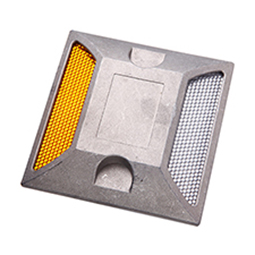
The housing serves as the first line of defense for road studs against external forces such as vehicle rolling and environmental erosion. Plastic housings are inexpensive but have extremely poor UV resistance and impact resistance; prolonged exposure to sunlight causes them to age and become brittle, and they are highly prone to cracking and breaking under vehicle rolling. They are only suitable for low-speed, light-load scenarios such as residential communities and industrial parks and cannot be used in main road projects.
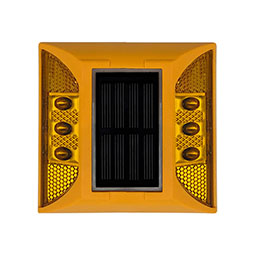
High-end engineering-grade products all utilize die-cast aluminum alloy housings manufactured through a one-piece molding process. These feature high compressive strength, corrosion resistance, UV resistance, and resistance to deformation. They can withstand repeated rolling by heavy-duty trucks, impacts from gravel, and exposure to wind and sun over the long term, making them perfectly suited for harsh environments such as highways, mining areas, and coastal regions. HOAN die-cast aluminum solar road studs, thanks to their robust housing structure, significantly extend the product’s overall service life and reduce the likelihood of damage from external forces.
Most early failures of solar road studs are not caused by damaged batteries or LEDs, but rather by water ingress, dust accumulation, and corrosion-induced short circuits resulting from seal failure. Long-term road flooding, rainwater runoff, and coastal salt fog penetration can all seep through seal gaps into the device, corroding circuit boards and batteries and rendering the equipment inoperable.
Products with low protection ratings such as IP65 and IP67 can only withstand brief exposure to rain and are unsuitable for environments with prolonged water accumulation or high humidity. In contrast, HOAN Traffic solar road studs utilize an IP68 fully sealed process, combined with an integrated potting resin and dual-layer sealing gasket structure, to completely block the intrusion of moisture, dust, and salt fog, eliminating seal failure issues and ensuring long-term, stable operation even in harsh weather conditions.
High-quality solar road studs use tempered glass monocrystalline silicon solar panels, which feature a wear- and scratch-resistant surface, resistance to UV aging, and high charging efficiency even in low-light conditions. They do not experience efficiency degradation over years of use. In contrast, low-end products use ordinary, inferior solar panels that are prone to aging and yellowing when exposed to prolonged sunlight, resulting in reduced light transmittance. Charging efficiency decreases year by year, leading to insufficient power storage and an inability to illuminate during cloudy or rainy weather, which indirectly shortens the product’s service life.
Even the best products require proper installation to ensure longevity. An uneven installation surface, air pockets beneath the unit, or incomplete adhesive filling can all lead to uneven stress distribution on the housing and seal cracks, significantly shortening the service life. Additionally, harsh operating conditions—such as heavy vehicle traffic, salt fog corrosion, and exposure to sandstorms and intense sunlight—can accelerate equipment aging, necessitating the selection of high-performance products specifically tailored to the environment.
Urban roads feature moderate traffic flow, few heavy-duty vehicles, and a mild environment, offering favorable operating conditions. Standard plastic road studs have a service life of approximately 2–4 years, whereas HOAN’s cast aluminum engineering-grade solar road studs can operate reliably for 5–7 years in typical municipal settings, with virtually no frequent failures and extremely low maintenance costs.
Expressways feature high vehicle speeds, dense traffic of heavy vehicles, and frequent rolling, placing extremely high demands on a product’s compression resistance, vibration resistance, and sealing performance. Ordinary products are highly prone to breakage and failure, whereas HOAN’s heavy-duty cast aluminum road studs—such as the HA-RS-143N and HA-RS-150—are specifically designed for highway conditions. Their service life in real-world projects can reach 5–8 years, making them suitable for long-term, high-intensity traffic scenarios.
Coastal areas are characterized by high humidity and highly corrosive salt fog, causing ordinary road studs to corrode easily and suffer seal failure. HOAN’s corrosion-resistant IP68 cast aluminum solar road studs undergo special anti-salt-fog treatment to withstand long-term corrosion. With a service life far exceeding that of standard products, they are well-suited for the long-term operation and maintenance needs of coastal roads.
Mining area roads are characterized by severe vibrations, high dust levels, and 24-hour continuous operation, presenting the most demanding operating conditions. HOAN’s reinforced heavy-duty solar road studs are vibration-resistant, impact-resistant, dustproof, and corrosion-resistant, making them suitable for high-intensity mining environments and effectively reducing the frequency of equipment replacement.
Many procurement pitfalls stem from misconceptions. First, the mistaken belief that because LED chips have a long lifespan, the overall product lifespan is also long—when in fact, the battery, seals, and housing are the key factors determining service life; Second, the belief that all lithium-ion batteries perform identically—yet substandard refurbished or standard lithium-ion batteries degrade far faster than lithium iron phosphate (LiFePO₄) batteries; third, neglecting installation procedures—improper installation can directly damage the sealing structure of high-end products, significantly shortening their service life; fourth, confusing laboratory-rated lifespan with real-world operational lifespan, and overlooking the impact of harsh environments on product wear and tear.
To maximize the service life of equipment and reduce the overall project cost, it is essential to maintain control throughout the entire process. During the procurement phase, for harsh environments such as highways, coastal areas, and mining sites, prioritize engineering-grade products featuring lithium iron phosphate (LFP) batteries, cast aluminum housings, and IP68 full sealing. Before bulk procurement, be sure to request samples and conduct compression, water immersion, and high/low-temperature aging tests to verify product quality. During installation, ensure the base surface is level and the adhesive is fully applied to prevent hollow installations; do not open the road to traffic until the adhesive has completely cured. For routine maintenance, regularly clean sand and dust from the solar panel surface, and conduct annual inspections for housing damage and seal aging, performing timely maintenance to effectively extend the equipment’s service life. Additionally, procurement decisions should focus on the product’s total cost of ownership rather than the unit purchase price alone; low-cost, short-lived products will actually increase long-term maintenance expenses.
HOAN Traffic has been deeply involved in the field of road safety equipment for many years, focusing on the R&D and production of engineering-grade, long-life solar road studs. We ensure product durability through comprehensive measures covering core components, process design, and quality control testing. The entire product line is equipped with high-cycle lithium iron phosphate batteries, which provide stable power storage and exhibit slow capacity degradation; it features a thickened die-cast aluminum alloy housing that is pressure-resistant, corrosion-resistant, and resistant to aging and impact; They come standard with a true IP68 fully sealed potting process, making them impervious to water accumulation, salt fog, and dust erosion.
Paired with high-transmittance tempered glass solar panels, their charging efficiency remains consistent over the long term. Additionally, they hold a full suite of international certifications—including CE and RoHS—as well as third-party compression and waterproof testing reports, making them suitable for various global bidding projects and harsh operating conditions. Whether for highway, municipal, coastal, or mining projects, HOAN solar road studs deliver long-term, stable performance, significantly reducing post-installation maintenance and replacement costs, making them a high-quality, long-lasting solution for global road infrastructure projects.
The service life of solar road studs is never determined by the theoretical parameters of the LED chips alone, but rather by a combination of battery quality, housing material, sealing process, installation standards, and operating environment. Laboratory-rated lifespans cannot be equated with actual service life under real-world road conditions. While low-cost, low-specification products may seem to save on procurement costs, they can significantly increase overall O&M expenses due to frequent failures and replacements.
For various road engineering scenarios, selecting engineering-grade solar road studs with cast aluminum housings, lithium iron phosphate batteries, and IP68 full sealing—combined with proper installation and regular maintenance—can maximize the service life of the equipment and ensure the long-term stability and effectiveness of road markings. For detailed specifications, project case studies, and bulk purchase quotes for HOAN’s long-life solar road studs, please visit the HOAN Traffic official website at haroadstud.com. You can request free samples for field testing and receive a one-on-one engineering selection plan.