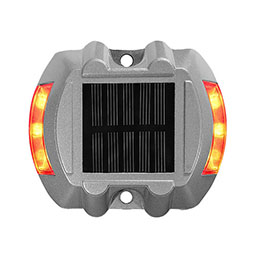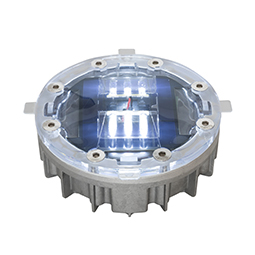

Solar road studs are widely used on highways, urban roads, parking lots, and rural roads due to their advantages, such as no wiring required, active illumination, and energy efficiency and environmental friendliness. However, in many projects, problems such as loosening, upturned, and detachment of the road studs occur shortly after they are put into use. Loose road studs lose their nighttime guidance function, become damaged after being repeatedly run over by vehicles, pose traffic safety hazards, and simultaneously lead to increased rework costs, delayed project acceptance, and more after-sales disputes.
In fact, most cases of loosening in solar road studs are not due to substandard product quality, but rather result from improper product selection, inadequate preparation of the road subbase, and non-standard installation practices. This article will systematically explain a comprehensive solution to prevent the loosening of solar road studs, covering product selection, construction procedures, adaptation to different road surfaces, and post-installation inspection and maintenance. HOAN Traffic offers cast aluminum solar road studs with built-in reinforcement structures, which significantly reduce the risk of loosening at the hardware level.
If the road surface is uneven, pitted, or contaminated with residual oil, loose dust, or gravel, the adhesive cannot bond tightly to the surface, causing the road studs to gradually detach and loosen. Thermal expansion and contraction of asphalt surfaces, as well as cracking in concrete surfaces, can cause the subgrade to deform, pulling on the road stud bases and resulting in displacement.
Thin plastic road studs lack embedded mounting feet or screw-fastening holes and rely solely on adhesive bonding, making them highly prone to loosening on heavy-traffic sections. Products with insufficient compressive strength will have their bases deform after repeated rolling by heavy vehicles, causing them to detach completely from the road surface. In contrast, dual-fixation road studs with embedded mounting feet and screw holes offer superior resistance to impact and vibration, making them more suitable for heavy-traffic roads.
Incorrect drill hole dimensions prevent the anchor feet from effectively gripping the base layer; incorrect selection or improper application of adhesive; opening the road to traffic before the adhesive has fully cured; failure to level the surface during installation, leading to gradual loosening due to concentrated stress at a single point; and forcing installation in damp, rainy, or cold conditions—all of which can cause the epoxy adhesive to fail to cure properly, creating hidden risks of loosening.
Impact and vibration from tires, scraping and prying of road studs during winter snow removal operations, and long-term rainwater penetration cause the adhesive layer to age and peel off. If regular inspections are neglected and minor loosening is not repaired in a timely manner, it can quickly escalate to road stud detachment.
The mounting method directly determines long-term stability. The table below compares two mainstream mounting solutions to help project managers make informed choices based on road conditions:
|
Fixing method |
Applicable Scenarios |
Stability evaluation |
|
Surface adhesive |
Light-duty parking lots |
Relying solely on glue makes |
|
Double fixing with pre-embedded feet + epoxy |
National highways, |
Mechanical locking + adhesive double |
When selecting a model, focus on four key criteria: a one-piece cast aluminum housing, extended pre-embedded mounting feet, pre-drilled screw holes, and high compressive strength with IP68 waterproofing. HOAN’s cast aluminum solar road studs feature an integrated reinforced base and a dual-fixation design, significantly reducing the likelihood of loosening. For municipal sidewalks and small parking lots, the PC plastic model is suitable; for national highways, expressways, and freight corridors, the cast aluminum reinforced model should be prioritized.
Before construction, remove oil stains, loose dust, and loose gravel. Damp road surfaces must be dried; installation on wet surfaces is strictly prohibited. Check the road surface for levelness and repair potholes in advance; direct installation of road studs on large areas of damaged pavement is not recommended. When drilling holes, ensure they match the dimensions of the road stud’s mounting foot, control the hole depth and diameter, and clear dust from the holes to ensure the mounting foot effectively grips the subbase.
The correct installation process is: positioning and layout, drilling and dust removal; Select road-grade epoxy structural adhesive, which is resistant to high and low temperatures, waterproof, and vibration-resistant; ordinary adhesives are highly prone to aging and detachment; apply adhesive evenly, insert the spike shank and level it into position, and remove any excess adhesive to prevent it from covering the reflective lens; allow for sufficient curing and curing time; in low-temperature environments, appropriately extend the curing period, and close the road to traffic until curing is complete; on heavy-traffic sections, install additional stainless steel expansion screws to achieve dual fixation through both adhesive bonding and mechanical fastening.
Asphalt pavements exhibit significant flexible deformation; therefore, road studs with anchor feet paired with high-performance epoxy adhesive are the preferred method—simple surface bonding is not recommended. For concrete pavements, the primary methods involve drilling holes and installing expansion screws followed by epoxy sealing, with mechanical fastening being the dominant approach. For parking lots with light vehicle loads, the installation process may be appropriately simplified; however, due to frequent braking impacts near entrances/exits and speed bumps, reinforced road studs are still recommended.
Focus on inspections during the first three months of a new project, then switch to quarterly inspections. Check for wobbling, gaps, or upturned in the road studs. If even slight loosening is detected, promptly remove the stud, clean off the old adhesive, and reinstall it with reinforcement to prevent minor displacement from rapidly escalating into stud detachment.
With proper selection and standard installation, HOAN cast aluminum solar road studs can provide stable service for many years. Inferior products or improper installation may cause them to loosen and fall off within a few months.
If only slightly loose, it can be removed, the residual adhesive cleaned off, and then reinstalled; however, if the base or road surface is severely damaged, the stud must be replaced at a new location.
For heavy-duty roads, dual fastening with screws and epoxy adhesive is the most reliable; the mechanical locking mechanism significantly resists vibration and impact.
Preventing the loosening of solar road studs requires a comprehensive approach: suitable anti-loosening structural products, proper substrate preparation, standardized installation procedures, and regular inspection and maintenance—all of which are essential.
If you are looking for anti-loosening, high-load-bearing solar road studs for highway or parking lot projects, HOAN Traffic offers cast aluminum solar road studs with reinforced embedded bases, available for project-specific customization. Visit haroadstud.com to view product specifications, and contact us for engineering solutions and installation guidance.