
In North America, Northern Europe, Russia, and the cold northern regions of China, mechanized snow removal is a standard practice in winter road maintenance. For municipal roads, highways, and rural thoroughfares equipped with solar-powered road studs, snowplow operations have long been the biggest challenge in terms of equipment wear and tear. Many engineering and maintenance teams report that the failure rate of standard solar road studs exceeds 30% after a single snow season, with various malfunctions such as cracked housings, detached lights, water ingress causing short circuits, and light failure.
Frequent replacement of damaged solar road studs not only significantly increases road maintenance costs and wastes manpower and resources but also leads to the absence of road markings during winter nights, posing a major traffic safety hazard. Many engineering procurement and construction personnel have questions: Are solar road studs incompatible with mechanical snow removal operations? Is there a way to completely prevent equipment damage caused by snow plows? In fact, damage to road studs is not due to product defects but is mostly caused by incorrect product selection, improper layout, and non-standard installation. This article will conduct an in-depth analysis of the core causes of solar road stud damage during snow removal operations. It will share selection criteria, layout plans, installation techniques, and winter maintenance tips tailored to snowy conditions. Combined with HOAN Traffic’s solar road studs specifically designed for extremely cold climates, this article provides a comprehensive, practical protection solution for snowy road projects.
To prevent equipment damage at its root, we must first identify the core factors causing damage to solar road studs during snow removal operations and break the vicious cycle of blind replacement and repeated damage. The vast majority of damage issues involving snow-covered road studs can be attributed to four key factors: product design, installation, layout, and environmental conditions.
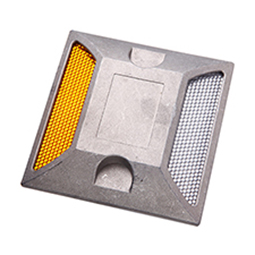
First are product structural defects. Commonly available surface-mounted, high-profile road studs and plastic-cased road studs are the most susceptible to damage. These studs protrude significantly above the road surface, causing snowplow blades to directly snag or collide with the lights as they pass; furthermore, the plastic material rapidly becomes brittle in low-temperature environments, cracking and shattering upon even minor impact, rendering them completely unable to withstand the impact forces of mechanical snow removal. Second is improper installation. Many installations rely solely on adhesive bonding without mechanical anchoring, meaning even a slight scrape from a snowplow blade can lift the entire stud out of the ground.
Third is improper placement. Installing studs directly in the path of vehicle tires or within the primary scraping zone of snowplow blades significantly increases the likelihood of damage. Finally, there is damage from low-temperature corrosion. Even if the road studs are not directly shattered by impact, the force of the impact and compression can damage the sealing structure, allowing winter de-icing brine, snowmelt, and ice water to seep into the device, corroding the circuit boards and batteries and causing the road studs to short-circuit and fail later on. As can be seen, by specifically optimizing the selection, installation, and operation and maintenance plans, the failure rate of road studs can be minimized.
For road projects in extremely cold and snowy regions, it is absolutely imperative not to apply the standard selection criteria for ordinary road studs used in temperate regions. To withstand the wear and tear of mechanical snow removal operations, four core conditions must be met: low profile, high hardness, strong sealing, and resistance to cold and corrosion. These are the key factors that distinguish ordinary road studs from those specifically designed for snowy conditions.
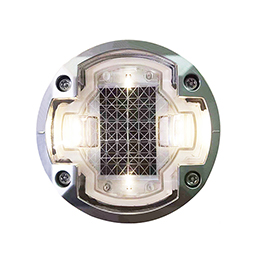
Surface-mounted road studs are a major no-go for snow-covered road projects, as their high-profile design makes them highly susceptible to being snagged or struck by snowplow blades. For roads in extremely cold and snowy conditions, embedded solar road studs are the top choice. Installed by cutting grooves into the road surface, their low-profile design ensures the entire unit lies flush with the road surface. Snowplow blades can glide smoothly over them without any snagging points or impact resistance, structurally preventing physical damage caused by mechanical snow removal. This is currently the most reliable solution for snowy roads. The HOAN Traffic HA-RS-143N embedded solar road stud, specifically developed for snowy conditions, features a low-profile design that is perfectly suited for routine mechanical snow removal operations.
In low-temperature environments, plastic materials become extremely brittle, and their impact resistance drops significantly, making them completely unsuitable for major snow-covered roads. Engineering-grade snow-road studs must utilize die-cast aluminum alloy housings. This material is hard yet sufficiently tough; it does not become brittle or crack in low-temperature environments. It can continuously withstand scraping, rolling, and impacts from snowplows, maintaining the housing’s integrity without deformation or cracking over the long term, making it suitable for high-frequency snow removal operations.
De-icing brine used on winter roads is extremely corrosive. With standard IP65 or IP67-rated road studs, brine easily seeps through sealing gaps, corroding internal circuits and rendering the lights inoperable. Snow-specific road studs must come standard with IP68 fully sealed waterproofing, featuring a fully encapsulated design that isolates the unit from ice, brine, and snow erosion. This eliminates seal failure caused by freeze-thaw cycles and ensures stable, all-weather operation throughout the winter.
In extremely cold regions, winter temperatures can drop as low as -40°C. Standard lithium batteries are highly prone to entering sleep mode, experiencing power degradation, and becoming inoperable. High-quality snow-specific road studs are equipped with cold-resistant lithium iron phosphate (LiFePO₄) batteries that maintain stable performance at low temperatures and withstand extreme cold. Additionally, their curved top surface design allows snow to slide off naturally, preventing the solar panels from being covered by snow and ensuring normal light absorption and charging during winter.
Selecting the right product is only the foundation; scientific layout planning and standardized installation are the key to minimizing damage to the road studs—a critical aspect that is often overlooked in many projects. Based on snow-covered road conditions, we have developed a set of dedicated layout and construction specifications.
When planning road stud installation points, avoid vehicle travel paths and the primary scraping paths of snowplows as much as possible, prioritizing placement on road shoulders and offset positions along the edges of traffic lanes. For long, straight sections with extremely high snow removal frequency, a hybrid layout approach can be adopted: use cost-effective reflective road studs on standard sections, and install solar-powered road studs only at hazardous locations such as curves, slopes, and intersections. This ensures safety while reducing equipment wear and budget waste. If installation within the travel lane is unavoidable, be sure to use recessed, low-profile models and avoid high-profile road studs.
In snowy conditions, installation using adhesive alone is strictly prohibited, as long-term freeze-thaw cycles and mechanical abrasion can easily cause detachment. Standard installation requires a dual-fixation method combining mechanical screw anchoring and high-strength epoxy adhesive: screws secure the main body of the stud, while the adhesive seals and fills the gaps, creating dual protection. Additionally, ensure the installation surface is level and free of hollows, and that the studs are installed horizontally without any tilt. Tilted studs can act as anchor points for snowplow blades, making them highly susceptible to impact damage. After installation, fill all surrounding gaps to prevent saltwater penetration, which can cause freeze-thaw expansion and structural damage.
Road maintenance teams must mark the locations of the studs in advance and inform snow removal personnel to adjust the height of snow plows appropriately. This prevents the blades from scraping the ground forcefully, reduces violent impacts on the road studs, and maximizes equipment protection without compromising snow removal effectiveness.
Most road stud damage issues in extremely cold regions stem from mistakes in installation and product selection. First, using adhesive-mounted, highly protruding plastic road studs on mechanically plowed sections of main roads results in an extremely high failure rate; second, relying solely on adhesive for fixation—without mechanical anchoring—makes the studs highly susceptible to detachment during snow removal operations; Third, installing a large number of standard road studs in the core traffic lanes without optimizing for embedding; fourth, neglecting corrosion from de-icing brine and selecting products with low protection ratings, which are highly prone to internal short circuits in winter; fifth, lacking a winter inspection and maintenance mechanism, allowing damaged road studs to remain in place for extended periods and compromising road safety. Avoiding these pitfalls can directly reduce equipment wear and tear by more than 80%.
Proper winter operation and maintenance can effectively reduce equipment failures and extend the service life of road studs. After heavy snowfall, use a soft-bristled brush to gently clear snow from the surface of the solar panels. Do not scrape with hard metal objects to avoid scratching the tempered glass surface, which could impair light absorption and charging. After each snow removal operation, promptly inspect the condition of the road studs to check for issues such as cracked casings, loose equipment, or water ingress causing malfunction.
At the end of each snow season, conduct a comprehensive inspection and maintenance. Re-seal any gaps, repair loose components, and prevent secondary damage caused by freeze-thaw cycles and saltwater penetration in the coming year. Additionally, stock an adequate supply of spare road studs as needed to enable quick replacement and ensure that road markings remain complete and effective around the clock.
Addressing the challenges of roads in extremely cold and snowy regions, HOAN Traffic has developed a dedicated snow-resistant engineering solution. Its embedded cast-aluminum solar road studs are perfectly suited for mechanical snow removal operations, making them the product of choice for icy roads in northern regions and overseas projects in extremely cold climates. The product features a low-profile, embedded design that prevents snagging and collisions with snowplows at the source; the thickened cast-aluminum housing resists low temperatures, withstands impacts, and prevents brittle cracking.
The entire product line comes standard with genuine IP68 fully sealed construction, making it impervious to corrosion from de-icing brine and extreme freeze-thaw cycles; equipped with specialized cold-resistant batteries, it operates reliably in extreme cold environments down to -40°C. A dual-fixation process using screws and adhesive eliminates the risk of detachment. The products hold a full suite of international certifications, including CE and RoHS, and support sample testing and bulk customization. We provide free installation plans and technical guidance for snow-covered road projects, significantly reducing winter maintenance and replacement costs.
In summary, the damage caused to solar road studs by snow plows is not an unsolvable industry challenge; the core issues lie in incorrect product selection, unreasonable layout, non-standard installation, and a lack of winter maintenance. For road projects in cold, snowy regions, by abandoning ordinary adhesive-mounted or plastic-cased road studs and selecting HOAN’s embedded, low-profile cast aluminum solar road studs—combined with scientific layout plans and standardized installation procedures—you can minimize equipment damage caused by mechanical snow removal, ensure clear nighttime road markings and safe passage during winter, and significantly reduce the project’s full-lifecycle operation and maintenance costs.
For detailed specifications on solar road studs designed for snowy conditions, project layout plans, and bulk purchase quotes, please visit the HOAN Traffic official website at haroadstud.com. You can request free samples for field testing and receive a one-on-one customized solution for cold-weather road projects.