During the bidding phase of overseas road projects, accurately calculating the procurement quantity of solar road studs directly impacts the project budget and the preparation of the Bill of Quantities (BOQ) in the bid proposal. Many contractors simply apply the formula “road length ÷ spacing,” overlooking the need for denser installation on high-risk sections such as curves, ramps, intersections, and tunnel entrances and exits. They fail to distinguish between single-side, double-side, and centerline installations, and do not account for construction wastage or future spare parts. As a result, they either face shortfalls in delivered quantities that force them to rush the schedule or waste funds due to over-purchasing.
Furthermore, many projects employ a mixed layout of solar-powered and reflective road studs but lack the knowledge to calculate the quantities for each product type separately. This article introduces the basic calculation formula for solar-powered road studs, section-by-section adjustment methods, and reference spacing guidelines for different road types. It explains the calculation logic for single-side, double-side, and mixed installations, as well as provisions for spare parts, and provides practical steps that can be directly applied to bid proposals. HOAN Traffic not only offers a full range of solar-powered and reflective road studs but also assists in verifying layout plans and estimating quantities based on clients’ road drawings, thereby reducing the risk of miscalculations in project scope. We provide quotes for both samples and bulk projects.
This formula provides only a theoretical reference value; the actual procurement quantity requires multiple adjustments and cannot be directly used in the Bill of Quantities (BOQ) for bid proposals.
Key Tip: Calculations must be broken down by section; the entire road cannot be treated as a single straight line for calculation purposes.
Step 1: Divide the Entire Road into Independent Sections
Divide the project into independent sections such as straightaways, sharp curves, ramps, intersections, and tunnel entrances/exits. Record the length of each section separately; never treat the entire road as a single straight line.
Step 2: Set Reasonable Installation Spacing for Each Section
10 to 15 meters for straight sections of expressways; 8 to 12 meters for straight sections of urban arterial roads; 8 to 12 meters for straight sections of rural roads; 5 to 8 meters for sharp curves, ramps, and tunnel entrances/exits; and 3 to 5 meters for denser installation at intersections and crosswalk areas.
Step 3: Calculate the Theoretical Quantity for Each Single-Line Installation
Calculate using the formula “Number per line = Section length ÷ Spacing,” and round up the result for each subsection.
Step 4: Multiply by the Number of Installation Lines
Multiply by 2 for installation on both shoulders; multiply by 3 for installation on both shoulders plus the median strip; keep the original value for single-side installation.
Step 5: Adjust the Mixed Installation Plan
Use reflective road studs on long, straight, low-risk sections; deploy solar-powered road studs on curves, intersections, and accident-prone areas. Calculate the quantities of solar-powered and reflective road studs separately and include them in the Bill of Quantities (BOQ).
Step 6: Allow for Waste and Spare Parts
It is recommended to allow for a 5% to 10% surplus to account for construction damage and future maintenance replacements; for large-scale, remote road projects, a spare parts ratio of 8% to 10% is recommended.
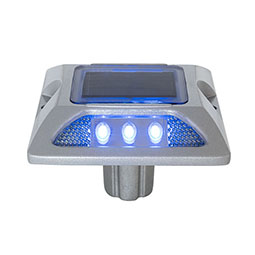
Brand Tip: HOAN Traffic can review your road layout drawings and provide recommended spacing and quantity guidelines for the HA RS 143N and HA RS 150 series solar road studs.
Note: The reference quantities below are calculated based on installation on both road shoulders (excluding the median strip) and are intended only for preliminary budget estimates. Final quantities must be determined in accordance with local traffic safety regulations and design drawings.
Spacing on straight sections: 10 to 15 meters, with adjustments for local curves and ramps; reference quantity for installation on both sides: approximately 130 to 200 per kilometer; additional units are required if installation is needed in the median strip.
Spacing on straight sections: 8 to 12 meters, with denser installation at intersections; with a recommended installation of approximately 160 to 250 per kilometer on both sides.
As there are many sharp curves, spacing must be reduced at bends; a recommended installation of approximately 160 to 250 per kilometer on both sides.
Overall spacing should be reduced by 20% to 30%, and the total quantity should be increased accordingly.
On long stretches of rural roads, deploy solar road studs only in high-risk areas and use reflective road studs on long, straight sections; this can significantly reduce the total procurement volume of solar road studs.
Confirm each item before calculation: Divide the road into multiple sections; set reasonable spacing for straightaways, curves, and intersections; multiply by the number of rows to be installed on one side, both sides, or the median strip; distinguish between mixed installations of solar-powered and reflective road studs; reserve 5% to 10% for spare parts; and verify against local road safety regulations.
The quantity of solar road studs cannot be determined solely by a simple division formula. Segmenting the road, adjusting for high-risk sections, considering installation methods, accounting for mixed configurations, and reserving spare parts are all indispensable steps in compiling an accurate Bill of Quantities (BOQ). If you need to calculate the quantity of solar road studs for a road project, please visit haroadstud.com to submit your road drawings and receive free installation and quantity recommendations, as well as a bulk quote.