Desert highways in the Middle East and Africa are facing a double challenge: in summer, road surface temperatures often approach 60 to 70 degrees Celsius; at the same time, frequent sandstorms cause fine sand to constantly wear down lenses and accumulate on solar panels. After a large number of standard consumer-grade solar road studs were deployed in desert projects, problems such as casing deformation, battery swelling, sand intrusion, and a sharp drop in charging efficiency quickly emerged. This led to widespread failure within a short period, resulting in extremely high costs for later operation, maintenance, and replacement.
Many overseas project procurement teams repeatedly ask: Can solar road studs truly withstand desert heat and sandstorms? The answer is clear—standard plastic models are not up to the task, but engineering-grade, heavy-duty solar road studs can perform reliably. When selecting products for desert projects, one must not focus solely on unit price; key technical specifications—such as housing material, cell type, and protection rating—are what truly matter.
This article will systematically analyze the primary causes of failure in solar road studs under the dual challenges of high desert temperatures and sandstorms, outline the hardware specifications that must be verified for desert projects, provide selection and installation recommendations tailored to specific scenarios, and share key points to avoid pitfalls in post-installation maintenance and procurement. HOAN Traffic’s HA‑RS‑143N and HA‑RS‑150 cast aluminum IP68 solar road studs are heat-resistant and sandstorm-resistant, specifically developed for desert highway projects. We support sample testing and the development of project-specific technical solutions.
In summer, desert road surface temperatures can reach 60 to 70 degrees Celsius. Low-quality plastic housings are prone to softening and deformation under sustained high temperatures, while standard lithium-ion batteries may swell and experience rapid capacity degradation when exposed to prolonged heat, leading to insufficient charging and premature failure of the road studs.
Sand particles continuously erode the surfaces of LED lenses and solar panels; a thick layer of sand covering the solar panels significantly reduces charging efficiency. Fine sand particles can also seep into the housing through gaps, damaging internal circuit components.
Desert regions experience drastic day-night temperature fluctuations. The repeated thermal expansion and contraction of sealed structures accelerate the aging and cracking of seals, allowing sand, dust, and dew to enter the interior of the housing.
Desert highways are often sparsely populated, with stations spaced far apart; frequent replacement of road studs results in high labor and logistics costs. Selecting the right product from the outset can significantly reduce the project’s total lifecycle cost.
Key Point: Most failures of road studs in desert conditions are not due to issues with the solar technology itself, but rather stem from inadequate housing materials, battery quality, and sealing performance.
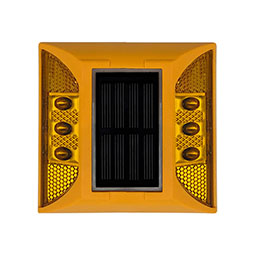
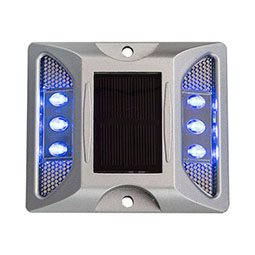
Die-cast aluminum alloy housings offer excellent heat dissipation, high-temperature resistance, and resistance to deformation. They can withstand the impact and abrasion of sand particles, making them the top choice for desert projects. Ordinary plastic housings, such as those made of ABS, are prone to softening, warping, and cracking under high desert temperatures and are not recommended for any open-air desert roads. The HOAN HA‑RS‑143N and HA‑RS‑150 models feature heavy-duty die-cast aluminum housings specifically designed to withstand extreme desert heat and sand impact.
Conventional lithium-ion batteries suffer severe capacity degradation and have a short lifespan when exposed to temperatures exceeding 60 degrees Celsius for extended periods; Lithium iron phosphate (LiFePO₄) batteries have a wider operating temperature range, are less prone to swelling, and offer a longer cycle life, making them better suited for sustained high-temperature desert environments.
The IP68 fully sealed potting process prevents fine desert sand particles, dust, and occasional desert dew and rain from entering the enclosure. IP65 and IP67 protection ratings cannot permanently block ultra-fine desert sand particles and should not be considered the minimum standard for desert projects.
The surface of tempered glass is wear-resistant and resistant to sand erosion; panels treated with a hard anti-dust coating reduce dust adhesion and maintain basic charging performance even when partially covered.
Heavy-duty trucks frequently travel on desert highways; road studs must possess sufficient compressive load-bearing capacity to prevent the housing from shattering after repeated rolling by vehicle wheels.
Brand Note: HOAN HA‑RS‑143N and HA‑RS‑150 incorporate all of the above desert-specific technical specifications and can provide third-party high-temperature and dust-proof test reports.
For long-distance desert highways with heavy traffic and numerous heavy-duty trucks, the HA‑RS‑143N embedded cast aluminum solar road studs should be the preferred choice; for desert suburban areas and low-speed side roads, the HA‑RS‑150 heavy-duty surface-mounted cast aluminum road studs may be selected. It is important to note that the large-scale use of inexpensive plastic road studs should be avoided on any open-air desert road.
Confirm each item before purchasing: cast aluminum alloy housing, high-temperature-resistant lithium iron phosphate battery, genuine IP68 sealing, tempered glass solar panel, dual-fixation with screws and adhesive, and simulated sample testing before placing an order.
Solar road studs can operate reliably in high-temperature desert environments and sandstorms, provided that engineering-grade models optimized for desert conditions are selected. Low-end plastic road studs cannot withstand long-term service in the desert. Product selection, standard installation, and regular cleaning and maintenance are equally important—all three are essential.
If you need to equip a desert highway project with reliable solar road studs, please visit haroadstud.com to view the HOAN Desert-Adapted Road Stud Series, request free samples, and get a quote for your desert highway project.