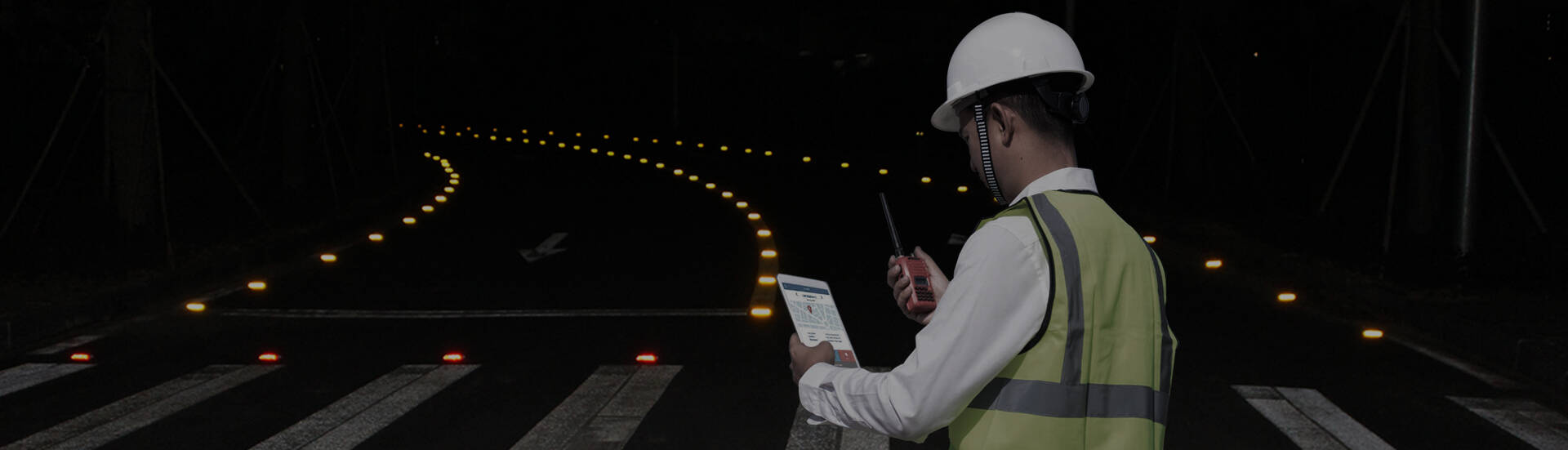
The road network within industrial parks includes main freight thoroughfares, warehouse loading and unloading areas, factory access roads, mixed-traffic lanes for pedestrians and vehicles, and employee and visitor parking lots. In many older industrial parks, street lighting coverage is inadequate, resulting in poor visibility at night. With trucks, forklifts, and pedestrians crossing paths, scrapes and collisions occur frequently. Traditional underground signage powered by the municipal grid requires excavation and wiring, leading to high retrofitting costs; construction also disrupts normal factory operations. Standard reflective road studs rely solely on headlight reflection at night and in rainy or foggy conditions, resulting in limited warning effectiveness.
Many general contractors for park infrastructure and facility managers are grappling with the question: Are solar-powered road studs suitable for roads within industrial parks? How should they select the appropriate models for areas with heavy trucks, loading and unloading zones, and parking lots? How should they address insufficient lighting in areas around some factory buildings where structures block sunlight? In the following sections, we will outline the application scenarios for various types of roads within industrial parks and the specific operating conditions of factory premises, providing selection criteria, recommended spacing, and installation guidelines to help parks control costs and reduce future operation and maintenance expenses. HOAN Traffic offers two main series of solar road studs—surface-mounted and heavy-duty embedded—suitable for both new industrial parks and renovations of existing ones. These products can handle heavy-duty trucks, dust and oil contamination, and partially shaded conditions within factory premises, and the company provides sample testing and project layout recommendations.
Heavy-duty trucks, forklifts, and passenger vehicles frequently cross paths within industrial parks, and certain road sections are subjected to repeated heavy-load rolling, placing high demands on the road studs’ compression resistance.
Road surfaces, warehouses, and cargo areas are prone to dust and oil contamination. These pollutants can easily cover the solar panels and LED lenses, affecting charging efficiency and lighting performance.
Insufficient sunlight around factory buildings, warehouses, and container yards limits the solar charging performance in certain areas, potentially resulting in inadequate illumination at night.
Most existing industrial parks cannot accommodate large-scale road excavation; renovations must not disrupt daily factory operations, placing higher demands on installation methods.
Driveways, loading/unloading zones, pedestrian walkways, and employee parking lots coexist. Different areas have varying safety signage requirements, necessitating customized installations.
Key Tip: Solar road studs for industrial parks must balance compressive strength, resistance to dust and oil contamination, flexible installation, and adaptability to localized shading; unit price alone should not be the sole consideration.
Eliminates the need for cable installation and large-scale excavation, shortens construction time, and minimizes disruption to the factory’s daily operations.
Active LED illumination clearly marks lane edges, loading/unloading zone boundaries, and pedestrian walkways, reducing the risk of collisions between trucks, forklifts, and on-site personnel.
Different light colors and flashing modes cover various areas, including main freight thoroughfares, warehouse aisles, loading/unloading zones, pedestrian walkways, and employee parking lots.
IP68 fully sealed products prevent dust and oil mist from penetrating internal circuits, simplifying daily on-site cleaning.
Powered by solar energy with zero electricity costs, these lights require less routine maintenance compared to grid-powered in-ground lights.
Brand Note: The HOAN Traffic Solar Road Stud Series meets all the performance requirements for the above industrial park projects.
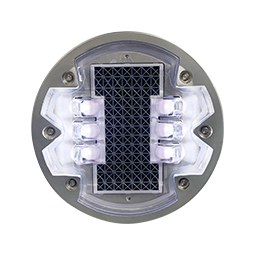
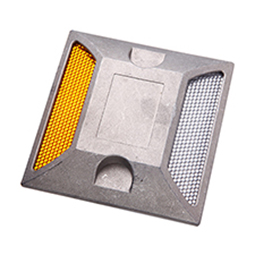
Challenge: Frequent rolling by heavy vehicles, requiring high compression resistance. Requirements: High compression load capacity, cast aluminum housing, IP68 sealing. HOAN Solution: HA‑RS‑143N recessed heavy-duty cast aluminum solar road stud.
Challenges: Frequent reversing by forklifts and trucks; heavy dust and oil contamination; high-risk areas for accidents. Requirements: High impact resistance; optional flashing warning mode; oil-resistant sealing. HOAN Solution: Heavy-duty cast aluminum solar road studs; flashing warning mode selected for the boundaries of loading/unloading zones.
Challenges: Large-scale trenching is not feasible during the renovation of existing facilities, and there is localized shading near factory buildings. Requirements: Trenchless surface mounting; excellent charging performance in low-light conditions. HOAN Solution: HA‑RS‑D3 surface-mounted solar road studs.
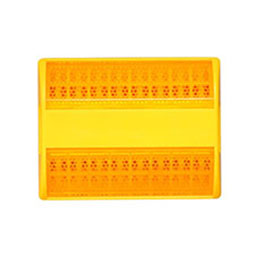
Challenges: Mixed pedestrian and vehicle traffic; low-speed movement; emphasis on boundary demarcation. Requirements: Moderate compression resistance; constant-on lighting mode; multiple color options. HOAN Solution: Cost-effective surface-mounted solar road studs.
Practical Tip: In areas adjacent to large warehouses with complete, permanent shading, deploying solar road studs is not recommended; reflective road studs or mains-powered signage should be used as a supplement.
Pre-project item-by-item verification: Match the compression resistance rating to vehicle load capacity; ensure IP68 dust, oil, and water resistance; select recessed or surface-mounted installation based on new construction or renovation; avoid locations with complete, permanent shading; use dual fastening with screws and adhesive; and complete sample testing before bulk production.
Solar road studs provide a practical, wireless safety marking solution for industrial park roads. Different models should be selected for heavy-duty truck lanes, loading/unloading zones, side roads, and parking lots, and locations with complete, permanent shading should be avoided. If you need to upgrade the road markings in your industrial park with solar road studs, please visit haroadstud.com to view our industrial park-compatible series, request free samples, and obtain a bulk quote for your facility’s roads.