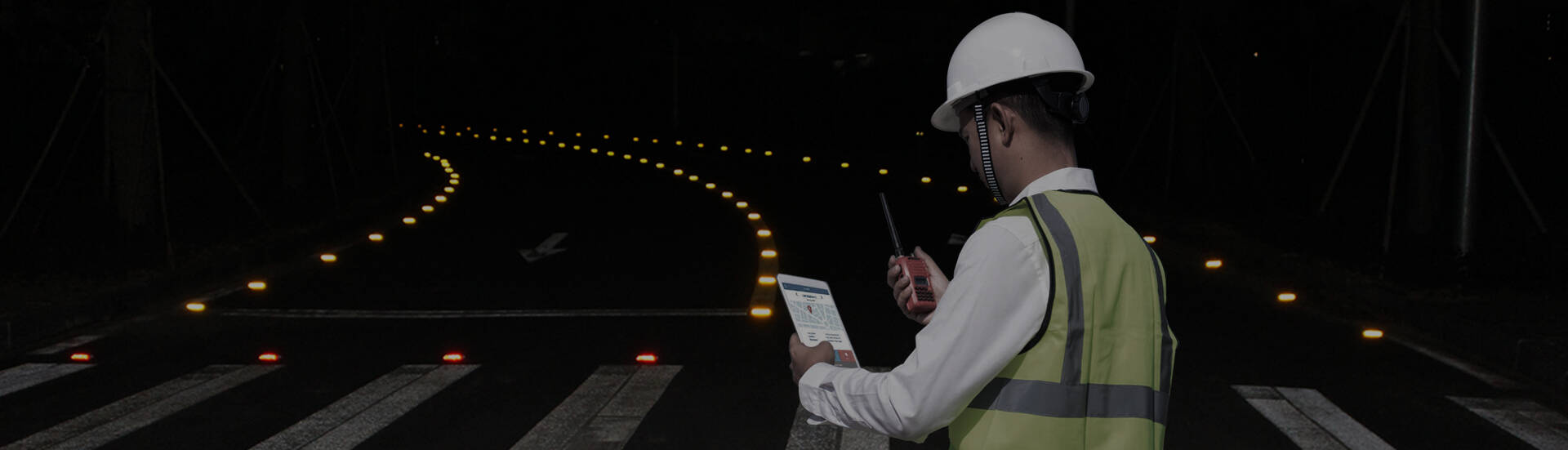
Airport runways, taxiways, and aprons have extremely stringent requirements for visual navigation markers. Traditional wired, embedded navigation lights require large-scale excavation of the pavement to lay cables; however, with underground fuel pipelines and communication lines densely crisscrossing the airport, renovation and expansion projects carry high risks and incur enormous costs due to the need to suspend operations during construction. Conventional reflective road studs rely on passive reflection, resulting in a significant reduction in visibility during fog, rain, and twilight conditions. After prolonged exposure to aircraft tire traffic, aviation fuel, de-icing fluid, and salt spray corrosion, conventional road studs are highly prone to cracking, leakage, and failure.
The most common questions from procurement teams for overseas airport projects are: Can solar-powered road studs be used on airport runways and taxiways? Which technical specifications are non-negotiable under airport operating conditions? This article outlines the applicability limits of solar-powered road studs at airports, analyzes the unique operational challenges of airport environments, and details mandatory selection criteria such as compressive strength, chemical corrosion resistance, protection rating, and visibility distance. It also distinguishes the key deployment and installation considerations for runways, taxiways, and aprons.
Frequent rolling traffic from aircraft tires, tow tractors, and heavy-duty airport service vehicles places far greater demands on the compressive load-bearing capacity of road studs than on ordinary roads.
Spilled jet fuel, de-icing fluid, and coastal salt fog can corrode the road stud casing and sealing mechanisms, leading to seal failure and damage to internal circuitry.
Dense fog, heavy rain, and environments with significant diurnal temperature fluctuations require road studs to remain clearly visible even under low-visibility conditions.
Airports have a dense network of underground utility lines; large-scale trenching for wired lighting fixtures would cause operational disruptions and pose safety risks.
Clear Application Limits
Solar-powered runway studs are suitable for auxiliary markings on taxiways, connecting roads, and aprons. According to ICAO Annex 14 requirements, they cannot completely replace wired, embedded navigation lights in the core areas of main runways.
Key Note: Solar-powered runway studs for airports cannot simply be substituted with standard highway-grade products; specialized embedded models designed for heavy-duty use and resistant to chemical corrosion must be selected.
There is no need for large-scale cable laying or trench digging, which significantly reduces the risk of damaging underground fuel pipelines and communication lines. The short construction window minimizes disruptions to airport operations.
Active LED illumination provides a longer visibility range and operates reliably in dense fog, at dusk, and in rainy conditions. It complements passive reflective markings, enhancing situational awareness for ground vehicles and pilots.
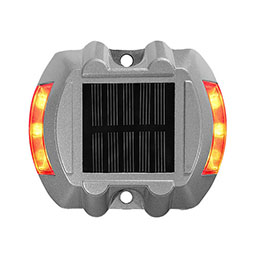
The cast aluminum embedded design withstands repeated heavy-duty rolling traffic, resists prying and loosening, and is suited for long-term airport operations.
IP68-rated full resin encapsulation, combined with a corrosion-resistant alloy housing, resists aviation fuel spills, de-icing fluid, and coastal salt fog corrosion, reducing premature equipment failure.
Powered by solar energy, these units eliminate ongoing electricity costs and are suitable for large-scale auxiliary markings on aprons and taxiways.
Brand Note: HOAN’s HA‑RS‑143N and HA‑RS‑A6 heavy-duty solar runway studs meet the aforementioned airport auxiliary marking requirements.
Important Note: Solar-powered road studs are used for auxiliary markings; lighting in the core areas of main runways must still comply with the standards for hardwired, embedded lights specified in ICAO Annex 14.
Challenges: Frequent aircraft taxiing and tow truck traffic require clear edge line contours; renovation and expansion projects aim to avoid large-scale excavation. Requirements: Recessed cast aluminum, high compressive strength, IP68 chemical corrosion resistance. HOAN Solution: HA‑RS‑143N recessed heavy-duty solar-powered runway studs.
Challenge: Mixed traffic of aircraft and service vehicles poses a risk of aviation fuel spills; large marking areas, with some sections obscured by aircraft wings. Requirements: Resistance to aviation fuel corrosion, good charging performance in low-light conditions, and dual-fixation installation. HOAN Solution: HA‑RS‑A6 Heavy-Duty Cast Aluminum Solar Road Studs.
Challenges: Frequent traffic of ground support vehicles; load-bearing requirements are lower than those for aircraft taxiways. Requirements: Cast aluminum housing, IP68 sealing, and high cost-effectiveness. HOAN Solution: Heavy-duty surface-mounted or embedded solar runway studs, selected based on pavement conditions.
In the core area of the main runway, wired, embedded navigation lights should be used in accordance with civil aviation regulations; areas beneath hangars that experience prolonged, heavy shading and insufficient charging are also unsuitable for deployment.
Confirm the following items before purchasing: Clearly define the scope of application—these are intended solely as auxiliary markers and do not replace wired runway navigation lights on the main runway; ensure sufficient compressive strength; verify the use of a chemically corrosion-resistant cast aluminum housing; confirm genuine IP68-rated full resin encapsulation; ensure dual-fixation via embedded grooving and screw-and-adhesive mounting; avoid areas with hangars that cause prolonged, heavy shading; and complete sample testing before bulk procurement.
Solar-powered runway studs are a practical, wiring-free auxiliary marking solution for airport taxiways, connecting roads, and aprons; however, they cannot replace the wired, embedded lights required by ICAO for the core area of main runways. When selecting models, prioritize heavy-duty, corrosion-resistant airport-grade embedded models over standard highway-grade products. If you need to procure solar runway studs for airport renovation or expansion projects, please visit haroadstud.com to view our airport-compatible heavy-duty series and request free samples.