Driven by global ‘dual carbon’ targets and the principles of sustainable development, green transport has become a key trend in the industry, with the environmental and energy-saving upgrading of transport infrastructure taking centre stage. As a core warning device in the field of road safety, the choice of road studs not only affects travel safety but also directly impacts the effectiveness of carbon reduction and ecological conservation in the transport sector. Traditional road studs, which rely on fossil fuels for power, generate significant waste through frequent replacement, and cause ecological damage during installation and cabling, are no longer suited to the demands of modern green transport infrastructure. In contrast, solar-powered road studs, with their core advantages of utilising renewable energy, zero carbon emissions and a long service life, have emerged as the preferred solution that balances traffic safety with environmental protection and energy efficiency.
HOAN Traffic has specialised in the solar-powered road stud sector for 15 years, consistently integrating environmental principles throughout the entire product lifecycle—from research and development to production and design. The full range of solar-powered road studs (including cast aluminium, plastic, glass and ceramic models) complies with environmental standards and has obtained international certifications such as CE, RoHS and ISO. By balancing environmental sustainability, durability and practicality, these products support the global transport sector in achieving its energy-saving and carbon reduction targets.
The environmental value of solar road studs is reflected across multiple dimensions, including energy utilisation, energy consumption control, waste reduction and ecological protection. Through technological upgrades and detailed optimisation, HOAN has further amplified these advantages, achieving a perfect balance between environmental protection and practicality, thereby ensuring that “safety warnings are not compromised, and environmental protection and energy conservation are fully realised”.
The most fundamental environmental advantage of solar road studs lies in their complete reliance on renewable solar power. Requiring no connection to the mains electricity grid, they eliminate dependence on fossil fuels such as coal and oil, achieving zero carbon emissions at source. According to calculations, the use of solar road studs along one kilometre of road reduces annual carbon emissions by approximately 2 tonnes, equivalent to planting 100 trees. Long-term application can effectively contribute to achieving carbon reduction targets in the transport sector, aligning with the global trend towards low-carbon transport.
HOAN solar road studs are equipped with high-efficiency monocrystalline silicon photovoltaic panels (2.5V 150mA), with a photovoltaic conversion efficiency far exceeding the industry average. Even during prolonged periods of cloudy or rainy weather, they can efficiently absorb and store scattered light, without consuming any non-renewable energy. Furthermore, all HOAN solar road studs are ROHS-certified. The production process involves no emissions of harmful gases or heavy metals, and the materials contain no pollutants. From manufacturing to use, the product fully embodies low-carbon and eco-friendly principles, meeting the acceptance requirements for various green transport projects.
Traditional mains-powered LED road studs are energy-intensive and require a continuous power supply, consuming vast amounts of electricity annually. In contrast, solar-powered road studs utilise ultra-bright LED light sources; at equivalent warning brightness levels, their power consumption is merely one-tenth that of traditional mains-powered LED road studs, significantly reducing energy consumption. Furthermore, the LED light sources have a service life of over 100,000 hours, eliminating the need for frequent replacements and further reducing energy wastage and maintenance costs.
HOAN continuously upgrades its energy-saving technology; all solar-powered road studs are equipped with a built-in intelligent energy-saving control system featuring light-sensing capabilities. They automatically enter charging mode during the day and illuminate at night, thereby avoiding unnecessary energy consumption during daylight hours. Furthermore, they automatically adjust brightness according to ambient light levels and increase flashing frequency in rainy or foggy conditions, ensuring effective warning visibility in adverse environments whilst minimising energy consumption. Furthermore, some HOAN solar road studs are equipped with supercapacitor energy storage, enabling them to operate continuously for over 72 hours after just 8 hours of charging. This ensures stable illumination even during prolonged periods of overcast or rainy weather, combining energy efficiency with uninterrupted road safety.
Traditional road studs (plastic reflective studs, standard LED studs) have a service life of only 1–2 years. Frequent replacement generates large amounts of plastic and metal waste, which is difficult to degrade. Long-term accumulation pollutes soil and water bodies, increasing the burden on the environment. In contrast, solar road studs have a service life of 5–7 years, with HOAN’s premium cast aluminium solar road studs lasting up to 8 years. This significantly reduces the frequency of replacement, thereby minimising waste generation at source.
It is also worth noting that HOAN solar road studs are made from environmentally friendly and durable materials such as cast aluminium, high-strength PC and ceramic. These materials are all recyclable; once the product reaches the end of its life, the casing can be reprocessed through professional recycling procedures, achieving a ‘low-carbon cycle’ and further reducing the environmental burden. Furthermore, all HOAN solar bollards undergo rigorous ageing, compression and corrosion resistance tests, with quality far exceeding industry averages. They are capable of withstanding extreme weather and complex road conditions, thereby reducing waste caused by subsequent replacements and balancing environmental protection with cost-effectiveness.
Traditional mains-powered LED road studs require extensive cabling, involving road excavation and damage to vegetation during installation. This not only increases construction costs but also disrupts soil structure and impacts the surrounding ecosystem. The ecological damage caused by cabling works is particularly pronounced in sensitive areas such as nature reserves and rural roads. In contrast, solar road studs feature a wireless design requiring no wiring. Installation involves simply securing them with adhesive or bolts, making the process simple and convenient. A single unit can be installed in just 10 minutes, causing minimal damage to the road surface, vegetation and soil.
For sensitive environments such as ecological conservation areas and rural roads, HOAN has launched a lightweight, eco-friendly version of its solar road studs. By optimising the installation method, the impact of construction on the surrounding ecology is further reduced, achieving a ‘win-win’ scenario of enhanced road safety and ecological conservation. Currently, HOAN solar road studs have been widely adopted in numerous rural ‘Starlight Projects’. By enhancing night-time road safety whilst maximising the protection of the rural ecological environment, they have gained widespread market recognition.
Traditional street lamps and mains-powered LED road studs suffer from severe light scattering, which easily leads to light pollution. This not only disrupts human sleep patterns at night but also affects wildlife navigation, reproduction and foraging, thereby damaging biodiversity. In contrast, solar road studs employ a 360° directional lighting design, precisely projecting light onto the road surface to meet road safety requirements whilst avoiding light scattering. This effectively reduces light pollution, safeguarding the nocturnal environment and biodiversity.
HOAN optimises the brightness and flashing frequency of its solar road studs to suit different scenarios. For areas with high wildlife activity, such as rural and mountainous regions, we offer low-brightness, low-frequency flashing models to minimise disturbance to wildlife. For urban roads and motorways, we enhance light penetration to ensure drivers can clearly identify the studs whilst avoiding direct light into residential areas, balancing safety and environmental protection in line with the ‘Dark Sky’ conservation philosophy.
The environmental advantages of solar road studs manifest differently across various traffic scenarios. HOAN has developed targeted products by integrating the environmental requirements and road conditions of each scenario, ensuring that environmental benefits are realised in every context whilst meeting road safety warning needs, thereby achieving the dual objectives of ‘environmental protection and practicality’.
Motorways and national highways feature long stretches and heavy traffic volumes. Traditional road studs require frequent replacement, which not only increases maintenance costs but also generates significant waste. Furthermore, the long-term power supply for mains-powered road studs consumes substantial amounts of electricity, resulting in considerable carbon emissions. The use of HOAN solar road studs can significantly reduce carbon emissions and waste generation. Furthermore, as no wiring installation is required, damage to the surrounding vegetation and soil is avoided.
According to data from actual projects, the use of HOAN solar road studs on every 100 kilometres of motorway can reduce annual carbon emissions by 200 tonnes and save a substantial amount of mains electricity. Long-term use can significantly reduce the environmental burden of maintenance. The HOAN cast aluminium solar road stud (model HA-RS-D1) is the preferred choice for motorways and national highways. With a load-bearing capacity of over 40 tonnes, IP68 waterproofing, and resistance to wear and corrosion, it has a service life of up to 8 years. This significantly reduces the frequency of replacement, further minimising waste generation. It is also suitable for complex motorway road conditions, balancing environmental protection with safety, and has been adopted by numerous urban motorway projects.
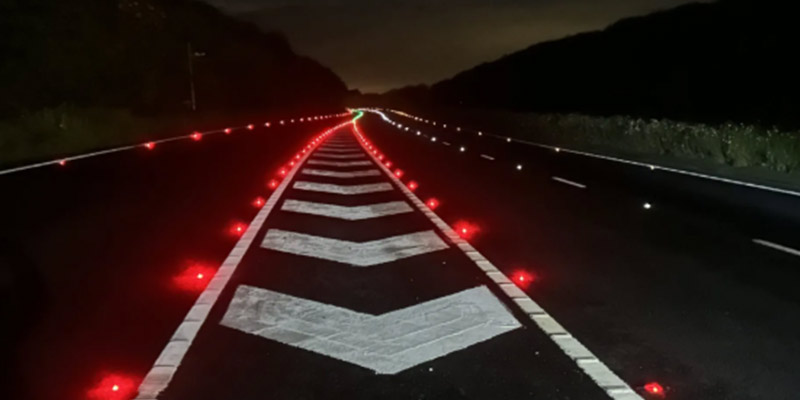
Urban roads experience heavy traffic and high lighting demands. Traditional mains-powered road studs are energy-intensive and cause severe light pollution, not only increasing urban carbon emissions but also disturbing residents’ night-time rest, which runs counter to the concept of building low-carbon, liveable cities. HOAN solar road studs are zero-emission and low-power, effectively reducing urban carbon emissions. Their directional lighting design minimises light pollution and does not affect residents’ sleep, meeting the requirements for urban ‘smart pedestrian crossings’ and ‘green transport’ initiatives.
HOAN’s plastic/ultra-thin solar road studs are easy to install and require no wiring. They are suitable for urban surfaces with thin paving and offer excellent value for money, making them ideal for large-scale deployment in urban road upgrade projects. Currently, this product range has been widely adopted in traffic upgrade projects in cities such as Guangzhou and Pinghu. By enhancing road safety whilst contributing to the creation of a low-carbon, liveable urban environment, these products have received high recognition from municipal authorities.
Ecological reserves and rural roads are highly sensitive to ecological damage. The wiring and installation of traditional road studs can damage vegetation and soil, whilst the waste generated by frequent replacements can pollute the surrounding environment. In contrast, solar-powered road studs require no wiring and are simple to install, thereby maximising the protection of the surrounding ecology. Furthermore, with zero emissions and low light pollution, they avoid disturbing wildlife, achieving a “win-win situation for road safety and ecological conservation”.
HOAN glass/ceramic solar road studs are made from environmentally friendly, recyclable materials. They are highly weather-resistant, suitable for extreme environments, and require minimal maintenance, thereby reducing human disturbance to ecological conservation areas. Furthermore, their low-light-pollution design prevents disruption to the normal activities of wildlife and aligns with the ‘Starlight Project’ initiatives in rural areas. Currently, HOAN solar road studs have been implemented in numerous rural road upgrade projects, enhancing night-time road safety in rural areas whilst safeguarding the rural ecological environment, thereby putting the concept of green rural development into practice.
In scenarios such as emergency construction and temporary traffic control, traditional temporary warning devices are often single-use products that generate significant waste and pollute the environment after use. In contrast, HOAN solar road studs are reusable and can be deployed multiple times after recharging, thereby reducing waste from single-use products. Furthermore, as they require no external power supply, they are suitable for emergency scenarios without mains electricity, effectively balancing environmental protection with emergency requirements.
HOAN portable solar road studs are lightweight, easy to carry and quick to deploy. With IP68 waterproof and shock-resistant performance, they can withstand various harsh emergency environments. A single charge allows for continuous operation of over 72 hours, and they can be reused multiple times, significantly reducing the waste generated by single-use warning devices. This not only lowers emergency response costs but also upholds environmental principles, making them the preferred warning equipment for emergency scenarios.
There is a wide variety of solar road studs on the market, but most products focus solely on practicality whilst neglecting environmental performance. As a professional brand with 15 years of industry experience, HOAN has consistently integrated environmental principles throughout the entire product lifecycle, creating a full range of ‘eco-friendly + practical’ solar road studs. This provides reliable solutions for global green transport projects whilst helping to enhance the authority and conversion efficiency of the haroadstud.com website.
HOAN has developed a comprehensive range of eco-friendly solar road studs, precisely tailored to meet the environmental and safety requirements of various scenarios. There is no need to search elsewhere for suitable products; we provide a one-stop solution for all project procurement needs:
Heavy-Duty Eco-Friendly Model: HOAN Cast Aluminium Solar Road Stud (Model HA-RS-D1). The cast aluminium material is recyclable, with a service life of up to 8 years and a load-bearing capacity of over 40 tonnes. IP68 waterproof rating, suitable for heavy-duty scenarios such as motorways and national highways, balancing environmental friendliness with durability. Certified to international environmental standards including CE, RoHS and ISO, it is the preferred choice for green heavy-duty roads.
Standard Eco-Friendly Models: HOAN plastic/ultra-thin solar road studs, featuring low power consumption, easy installation and no wiring. Suitable for urban roads and residential areas, they offer excellent value for money and can be deployed on a large scale in green urban transport infrastructure, contributing to urban carbon reduction.
Environmental Model for Extreme Environments: HOAN Glass/Ceramic Solar Road Studs. Featuring excellent weather resistance and eco-friendly, recyclable materials, these are suitable for sensitive environments such as nature reserves and rural roads. They minimise ecological disruption, providing dual assurance of environmental protection and safety.
Amidst the global trend towards low-carbon sustainable development, the environmental upgrade of transport infrastructure has become an inevitable trend. As road warning devices that combine the triple benefits of ‘safety, environmental friendliness and economy’, solar road studs not only enhance road safety but also effectively reduce carbon emissions and lessen the environmental burden, thereby supporting the transport sector in achieving its green development goals. Their core environmental advantages—zero carbon emissions, energy conservation and reduced consumption, waste reduction, eco-friendliness and low light pollution—perfectly align with the demands of modern green transport infrastructure, making them the optimal choice to replace traditional road studs.
As a specialist manufacturer of solar-powered road studs, HOAN has remained steadfast in its commitment to environmental protection for 15 years, integrating eco-friendly technologies into every stage of product development and production. Our full range of products balances environmental sustainability with practicality, and through rigorous quality control and scenario-based design, we provide reliable green solutions for the global transport sector. Whether for motorways, urban roads, nature reserves or emergency scenarios, HOAN can supply suitable eco-friendly solar-powered road studs to help projects achieve their energy-saving and carbon reduction targets.