As we navigate city streets, motorways, or country lanes each day, we inevitably encounter diverse road traffic signs. Traffic lights at junctions, motorway exit indicators, speed reduction warnings near schools... These seemingly ordinary markers silently safeguard every journey.
Conversely, missing or non-compliant signs often trigger serious issues. One rural road saw three rear-end collisions within six months due to absent sharp bend warnings; another commercial district intersection experienced 40% longer peak-hour congestion because of unclear directional signage. These cases demonstrate that road signs form the fundamental safeguard of traffic flow.
Road traffic signs constitute a standardised visual language composed of specific graphics, colours, and text. Without verbal communication, they rapidly convey core information such as traffic regulations, road directions, and potential hazards.
Whether for motor vehicle drivers, non-motorised cyclists, or pedestrians, they clearly indicate ‘what to do, what not to do, and where to go’. As the ‘foundational framework’ of the traffic system, they are core facilities ensuring orderly movement of people and vehicles while reducing accidents. Today, we comprehensively analyse ‘what road traffic signs are’.
According to China's national standard GB 5768.2-2009, Road Traffic Signs and Markings Part 2: Road Traffic Signs, road traffic signs are defined as ‘facilities that convey specific information to road users through graphic symbols, colours, and text for traffic management purposes.’
Internationally, the 1968 Vienna Convention on Road Traffic also establishes uniform standards for the design and application of road traffic signs, ensuring global interoperability. This signifies that road traffic signs inherently possess the core characteristics of ‘legality and standardisation’ from their inception.
(1) Immediacy: Instantaneous Information Transmission Requiring No Specialised Interpretation
The graphic and colour schemes of road traffic signs adhere to the principle of ‘extreme simplicity and clarity’. For instance, a red circle signifies prohibition, a yellow triangle denotes warning, and a blue rectangle indicates direction. Even individuals unfamiliar with written language can swiftly grasp the core meaning through these symbols. This intuitive nature ensures information transmission efficiency meets the high-speed demands of road travel.
(2) Mandatory Nature: Certain signs carry legal force and must be strictly adhered to
Core traffic signs such as prohibitory and regulatory signs possess explicit legal authority. Violations of speed limit signs, no-stopping signs, and similar regulations incur penalties including fines and penalty points. This mandatory nature serves as a crucial safeguard for regulating traffic behaviour and maintaining road order.
(3) Universality: Cross-regional and cross-vehicle recognition without barriers
Core design standards for road traffic signs remain consistent across different cities domestically and across nations internationally (where adhering to unified conventions). Simultaneously, they accommodate all road users—motor vehicles, non-motorised vehicles, and pedestrians—truly achieving ‘cross-scenario, barrier-free’ recognition.
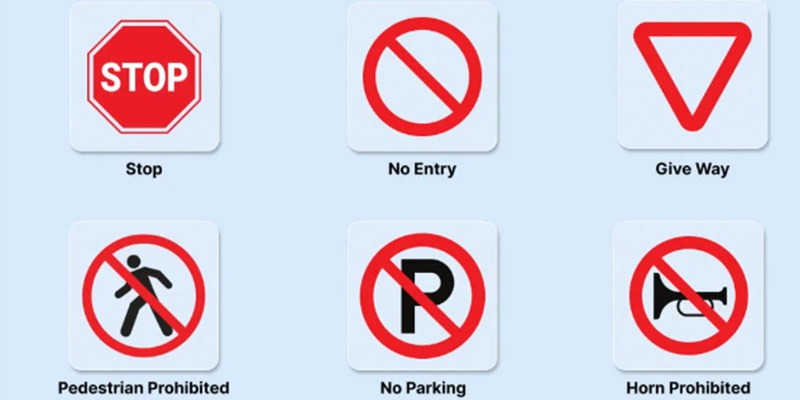
Based on functional differences, road traffic signs fall into four core categories, each with a distinct ‘specialised mission,’ collectively forming a comprehensive traffic guidance and management system.
Core Function: Anticipate hazards, prepare responses in advance
The primary role of warning signs is to alert road users to hazardous sections or special conditions ahead, prompting them to reduce speed and proceed with caution. They function as the road's ‘risk sentinels,’ providing advance notice of potential hazards.
Typical Design and Common Types
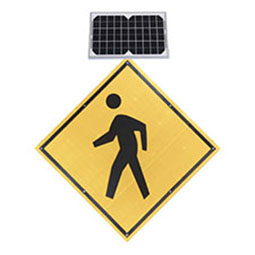
Featuring a ‘yellow background, black border, triangular shape’ design, they possess strong visual impact and can be rapidly identified in complex environments. Common types include sharp bend signs, steep gradient signs, caution for pedestrians signs, school zone signs, and roadworks signs.
Applicable Scenarios: High-Risk Sections and Special Areas
Primarily installed in high-risk zones such as mountain roads, school perimeters, construction zones, and intersections. For instance, consecutive sharp bend signs on mountain roads alert drivers to decelerate early, preventing rollover accidents caused by excessive speed.
Core Function: Establishing ‘Red Lines’ to Constrain Improper Traffic Behaviour
Prohibitory signs maintain road order by explicitly forbidding or restricting certain traffic behaviours. They directly delineate the ‘boundaries of conduct’ for road users, serving as a core means to reduce disorderly traffic.
Typical Design and Legal Attributes
Featuring a ‘white background with red border and circular design’, the red prohibitory colour enhances warning effectiveness. Common types include speed limit signs, no stopping signs, no turning signs, and no horn signs.
Notably, prohibitory signs carry strict legal authority. Violating their instructions incurs penalties under the Road Traffic Safety Act, including fines and penalty points. Serious offences may also incur civil or criminal liability.
Core Function: Clarifying Direction, Reducing Path Confusion
The primary role of directional signs is to provide road users with explicit guidance on travel direction, lane usage, or the location of specific facilities. They effectively reduce the time cost of ‘finding one's way,’ thereby enhancing road traffic efficiency.
Typical Styles and Common Types
Styles predominantly feature ‘blue background with white text/white graphics,’ commonly in circular or rectangular shapes. Common types include straight-ahead signs, left-turn signs, pedestrian crossing signs, bus lane signs, and car park directional signs.
Core Value: Adapting to Complex Intersection Requirements
Direction signs prove particularly crucial in intricate settings such as urban junctions and commercial district peripheries. For instance, lane direction signs at intersections clearly designate left-turn, straight-ahead, and right-turn lanes, preventing congestion caused by arbitrary lane changes.
Core Function: Conveying Long-Distance Information, Supporting Cross-Regional Travel
Direction signs primarily convey road names, destination distances, and facilities along the route (e.g., service areas, petrol stations), serving as the ‘core navigational tool’ for long-distance, cross-regional journeys.
Typical Styles and Information Hierarchy
Styles predominantly feature ‘green background (motorways/national roads), blue background (urban roads), white text’ in a rectangular design with clear information hierarchy. For instance, motorway directional signs clearly indicate upcoming exit names, distances, and connecting roads.
Specialised Types: Navigation for Specific Scenarios
Beyond standard directional signage, specialised types include tourist area signs (e.g., scenic spot guidance), operational zone signs (e.g., motorway diversion routes during works), and service area signs, catering to diverse navigational needs.
Beyond the four core categories, two indispensable supplementary sign types exist. One comprises auxiliary signs that do not convey independent information but clarify core signs' applicability (e.g., ‘No Parking 7:00-20:00’).
The other comprises roadworks safety signs, indicating detour directions and speed reduction requirements during construction to ensure traffic safety. These supplementary signs render the traffic signage system more comprehensive and precise.
Road traffic signs are not ‘superfluous adornments’ but rather ‘essential items’ for safe road operations. Their core value spans multiple dimensions including safety assurance, order management, and efficiency enhancement.
Warning signs provide advance alerts to hazards, prohibition signs restrain dangerous behaviour, and directional signs clarify traffic rules—the coordinated use of these three types of signs can reduce traffic accidents caused by ‘information gaps’ at their source.
Authoritative data reveals that after installing comprehensive warning signs for sharp bends and steep gradients on a mountainous highway, accident rates fell by 42%. Similarly, standardising lane directional signs at an urban junction reduced rear-end collisions by 38%. These figures unequivocally demonstrate their safety-enhancing value.
In areas with high concentrations of people and vehicles, the absence of traffic signage readily leads to chaotic ‘disorderly passage’. Directional signs and route indicators clarify travel paths, while prohibitory signs curb violations, effectively reducing congestion.
For instance, during peak hours in a commercial district, the installation of car park directional signs and no-parking signs improved junction efficiency by 35%, cutting congestion duration by nearly half an hour.
Standardised road traffic signs can replace some manual traffic direction duties. In scenarios such as remote sections and motorways, signs enable routine traffic management without requiring round-the-clock police presence, significantly reducing policing costs.
Simultaneously, traffic signs provide foundational information support for intelligent transport systems. Autonomous vehicles can accurately interpret traffic rules by recognising signs; traffic monitoring equipment, when integrated with signage, can more efficiently detect violations.
Road traffic signs can precisely link public facilities such as bus stops, car parks, tourist attractions, and hospitals. For instance, tourist area signs near attractions guide visitors to entrances swiftly; directional signs around hospitals direct vehicles to parking areas efficiently.
This integration reduces ‘navigational confusion’ during journeys, enhancing public satisfaction and convenience.
High-quality road traffic signs must meet three core requirements—‘durable materials, standardised design, and scientific installation’—to ensure long-term, stable functionality.
(1) Mainstream Base Materials: Balancing Lightness and Strength
Aluminium alloy panels serve as the primary base material for outdoor traffic signs, offering lightness, corrosion resistance, and high strength suitable for prolonged outdoor use. Stainless steel panels provide greater strength, adapting to harsh coastal environments with high salt spray, high temperatures, and humidity. Fibreglass materials exhibit strong wind load resistance, making them ideal for mountainous and windy regions.
(2) Core Process: Reflective Film as the Key to Night-time Safety
Retroreflective sheeting constitutes the core technology of traffic signs, directly determining night-time visibility. The appropriate grade of sheeting must be selected according to road classification: motorways and urban arterial roads require high-intensity or ultra-high-intensity sheeting to ensure clear visibility within 50 metres under night-time illumination; rural roads may utilise engineering-grade sheeting to balance cost and effectiveness. Premium sheeting boasts a service life of 5-8 years, exhibiting resistance to ageing and fading.
Designs must strictly adhere to GB 5768 standards, with no arbitrary modifications to graphics, colours, text sizes, or proportions. For instance, the red circle diameter for prohibition signs and the triangle side length for warning signs have precise dimensional requirements.
Information layout must adhere to the principle of ‘clear hierarchy’, avoiding excessive crowding of text and graphics to ensure drivers can grasp core information within 3-5 seconds. Simultaneously, sign dimensions must be adjusted according to road speeds: larger signs for higher speeds to ensure visibility from greater distances.
Installation height must accommodate road vehicle types: urban signs should be positioned 1.5–2.5 metres above ground level, while signs for large vehicles on motorways require heights exceeding 3 metres. Installation angles must align with road direction to prevent glare blind spots.
Critical junctures (intersections, forks, hazardous sections) require continuous signage to form a ‘guidance chain’, ensuring drivers receive effective information from any position and eliminating visual blind spots.
During the installation, procurement, and utilisation of traffic signs, widespread misconceptions exist that may diminish signage's fundamental purpose and even pose safety hazards.
Correction: Non-standard signs with irregular graphics, colours, or dimensions can easily mislead drivers. For instance, altering the red circle of a prohibition sign to another colour or reducing the size of a warning sign may prevent drivers from recognising it promptly, potentially causing accidents.
Furthermore, non-standard signs lack legal validity. Should disputes arise due to non-compliant signage, the managing authority may face legal liability.
Correction: Night-time and inclement weather conditions are peak periods for road accidents, when insufficient natural light renders standard signs difficult to discern. Retroreflective film reflects vehicle headlights back into the driver's field of vision, ensuring night-time visibility and serving as a core element for safe nocturnal travel.
Some users opt for low-grade or substandard reflective film to reduce costs. Such films degrade quickly, offer poor reflectivity, and may become ineffective within 1-2 years, thereby creating safety hazards.
Correction: Overly dense signage causes driver ‘visual fatigue,’ hindering rapid information processing and reducing traffic efficiency. For instance, installing over ten signs at an intersection may overwhelm drivers, causing them to overlook critical guidance.
The correct approach involves strategically placing signs at key junctures, emphasising core information, and eliminating redundant markings to ensure a concise, efficient signage system.
Road traffic signs serve as the ‘silent conductors’ of vehicular flow, bearing the core mission of safeguarding safety, regulating order, and enhancing efficiency. Their design compliance, material quality, and installation methodology directly determine road safety standards and management proficiency.
Whether for municipal road construction, motorway upgrades, rural highway renovations, or industrial/scenic area planning, selecting high-quality traffic signs compliant with national standards and suited to specific contexts is pivotal to enhancing project quality. With over a decade of specialised expertise in signage, we understand the requirements and challenges across diverse scenarios. We offer comprehensive solutions: from material selection, standard-compliant design, and bespoke manufacturing to professional installation and ongoing maintenance, providing end-to-end support for your project.