While energy efficiency and smart features are important selling points for solar street lights, the core requirement remains brightness. After all, the primary function of street lights is illumination—if lights aren't bright enough at night, pedestrians may trip due to poor visibility, drivers face increased accident risks from limited sightlines, and even theft risks rise in residential communities and industrial parks.
Brightness requirements vary by location. For instance, urban thoroughfares and large logistics park parking lots see constant traffic flow, demanding maximum brightness. Rural paths and community walking trails, however, only need sufficient illumination to clearly show the ground without dark spots. Choosing lights that fail to meet brightness standards means costly, time-consuming retrofits later.
Purchasers are often misled by superficial information, such as assuming “higher wattage equals brighter light.” This isn't true—I've seen many 100W solar streetlights that are less bright than 60W ones. The key lies in the efficiency of the LED chips, not just the wattage number.
Others obsess over “maximum lumens,” assuming higher is always better. But in practice, this often leads to either blinding glare or wasted light scattered into the sky or walls, leaving the ground inadequately lit. Additionally, some lights appear bright initially but dim significantly after six months, especially during rainy days when they barely stay on for hours—this stems from neglecting brightness stability.
This isn't just theoretical knowledge—it's a practical method combining real-world purchasing cases. Whether you're buying solar street lights for the first time or have previously fallen into brightness traps, this guide will help you understand: Which metrics should you look at to judge brightness? What factors affect a light's brightness? How to choose step by step to find products that are truly bright and stable.
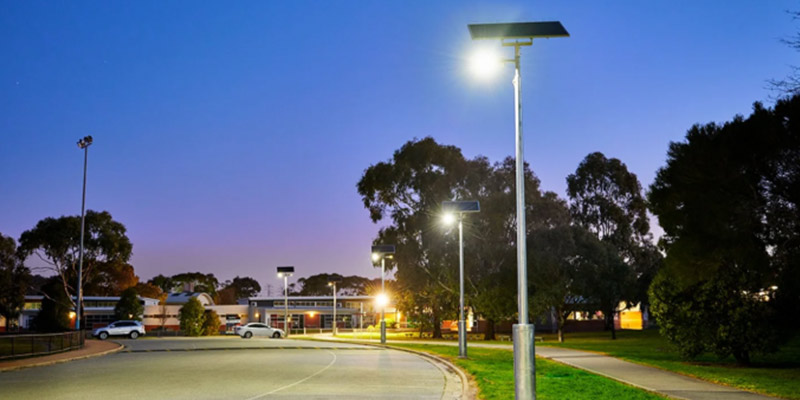
Lumens measure how much light a lamp emits. Simply put, higher lumens theoretically mean brighter light. But beware of manufacturers' “theoretical lumens”—values measured in labs differ significantly from the “effective lumens” actually illuminating the ground when installed on roadsides.
Here's a reference guide:
- Rural paths and community walkways: 3,000–5,000 lumens suffice. For urban side streets and factory roads, 5000-8000 lumens are required; For major urban thoroughfares and large parking lots, at least 8000-15000 lumens are necessary. When purchasing, always request the vendor to provide a test report for “effective lumens”—don't just rely on the numbers in the brochure.
Lumens measure the total light output of a lamp, while illuminance measures the actual light received on the ground, measured in lux. This is the metric most critical to user experience—for example, two 5000-lumen lamps may produce 15 lux or just 5 lux on the ground after installation, with the difference lying in optical design.
Specific illuminance standards exist for different scenarios: urban main roads require ≥30 lux, secondary roads ≥10 lux, and rural roads ≥5 lux. When purchasing, insist that suppliers provide third-party illuminance test reports. Ideally, request photos from installation cases similar to your scenario to visually assess whether the ground brightness is sufficient.
The same brightness level can appear different depending on color temperature. Cool white light (4000-5000K) offers clearer visibility and appears brighter, making it suitable for main roads and parking lots where detail recognition is crucial. Warm white light (2700-3500K) is softer and less intense, ideal for residential communities and parks where glare-free lighting is preferred.
Color Rendering Index (CRI) also matters—this metric determines how accurately a light source reproduces an object's true color. For instance, walking at night under low-CRI lighting might make a red warning sign appear dark red, leading to misjudgment. Opt for CRI ≥80 to ensure clear visibility and enhanced safety.
Some lights boast high peak brightness but cast glaring spots in the center while leaving large dark areas around the edges. This uneven distribution is more hazardous than insufficient overall brightness. To assess uniformity, examine the manufacturer's “light distribution curve”—a flatter curve indicates more even light dispersion.
If samples are available, test them in actual scenarios at night to check for noticeable dark spots or shadows. Ensure clear visibility remains consistent for pedestrians and drivers.
LEDs are the core light-emitting component of solar street lights, and their quality directly determines brightness. Opt for LEDs with chips from brands like Cree or Osram. These offer high luminous efficacy, emitting more light at the same power consumption, and exhibit slower brightness decay—high-quality LEDs maintain over 80% brightness after 5 years, while low-quality ones noticeably dim after just 1 year.
Also check the LED's luminous efficacy (lm/W)—higher values are better. For example, a 150 lm/W LED is brighter and more energy-efficient than a 120 lm/W one. Additionally, the arrangement of the LED chips matters: evenly spaced chips ensure more uniform light distribution, avoiding overly bright or dim spots.
No matter how bright the light, it's useless without power. The solar panel's power output and conversion efficiency are crucial. Opt for monocrystalline silicon panels with ≥20% conversion efficiency for faster charging and sufficient sunlight absorption even on cloudy days. Power output should match the light's brightness requirements—for example, a 10,000-lumen light needs at least a 60W solar panel.
Prioritize lithium batteries for storage capacity. Higher capacity means more stored energy and longer illumination duration. For regions with frequent overcast or rainy conditions, lithium batteries exceeding 100Ah are recommended to maintain high brightness during extended cloudy periods. Additionally, intelligent controllers are critical. High-quality controllers optimize charging and discharging—prioritizing high brightness during peak hours like evening rush and automatically dimming during late-night low-traffic periods. This approach saves energy while ensuring brightness during core usage times.
Optical design is often overlooked but significantly impacts ground illumination. High-quality solar street lights utilize PC or glass lenses with high light transmittance to reduce light loss. A well-designed reflector cup concentrates dispersed light onto the ground, enhancing illuminance.
Additionally, adjustable illumination angles are ideal. For narrow roads, a narrower angle concentrates light; for wide roads, a wider angle expands coverage. When purchasing, inquire about lens and reflector cup materials, as well as angle adjustability.
Different operating modes balance brightness and energy savings. For example:
- Urban main roads: Opt for “Constant High Brightness” mode to ensure sufficient illumination around the clock.
- Residential communities and side roads: Choose “Motion-Sensor Dimming” mode—low brightness standby when no people or vehicles are present, automatically switching to high brightness when detected, ensuring functionality while saving energy.
Additionally, “Time-Controlled Dimming” mode is available:
- Maintain high brightness during peak hours (e.g., 7 PM to 10 PM). then automatically dims after 10 PM, ideal for areas like campuses or residential complexes with lower foot traffic later at night. Select the corresponding operating mode based on your specific scenario.
Step 1: Clarify Your Requirements First
Before purchasing, consider three key questions:
List these requirements clearly. Then, based on the illuminance standards mentioned earlier, determine the lumens and illuminance values you need. This approach provides a clear objective during selection, preventing you from being misled by sellers.
Step 2: Pre-screen Products Based on Brightness Metrics
First, filter products based on lumen output to meet your needs. For instance, select 5,000–8,000 lumens for urban side streets. Then, carefully review the illuminance test reports for these products to confirm actual ground illuminance meets standards.
Next, examine the beam patterns and installation examples provided by vendors. Eliminate products with uneven lighting or noticeable dark zones. Compare multiple options at this stage and discard those that fail to meet requirements.
Step 3: Verify Core Components to Ensure Stable Brightness
This is the most critical step, directly determining whether the light can maintain brightness long-term. First, clarify the LED chip brand and luminous efficiency. Then examine the solar panel's power rating, conversion efficiency, and the battery type, capacity, and warranty period.
For example, ask: “What brand are your LED chips? What's their luminous efficacy? Is the solar panel monocrystalline or polycrystalline silicon? How many years of warranty does the battery have?” Reputable suppliers will clearly disclose this information and provide relevant test reports. If they give vague answers, the product likely has issues.
Step 4: Always Test Samples—Don't Just Take the Supplier's Word
No matter how convincing the supplier sounds, first obtain 1-2 samples for trial installation. In your actual environment, check at night whether the brightness is sufficient and uniform, test the sensitivity of motion sensors, and observe if brightness diminishes after continuous operation for several days.
If possible, use an illuminance meter to measure ground-level light intensity and confirm it meets standards. If samples fail these tests, bulk purchases will inevitably lead to problems—never skip this step.
Step 5: Evaluate suppliers—reliable after-sales support is essential
Choosing the right supplier is as crucial as selecting the right product. Opt for suppliers with extensive case studies and the ability to provide customized solutions—for instance, if installing in high-altitude areas requiring adaptation to low-light conditions, a reliable supplier will adjust solar panel and battery parameters based on your needs.
Also clarify after-sales guarantees: What is the warranty period for core components (LEDs, solar panels, batteries)? How quickly can they provide on-site repairs for brightness issues? Are spare parts available? Ensure these terms are included in the contract to avoid unresolved problems later.
As mentioned earlier, power rating does not equate to brightness. When purchasing, prioritize lumens and LED luminous efficiency. Don't be swayed by vendors touting “high power.” Request the LED parameter sheet from the vendor and verify details before placing an order.
Some vendors exaggerate theoretical lumen values while delivering low effective lumens. Insist on third-party brightness and illuminance test reports. Ideally, obtain photos or videos from installations similar to your project to visually verify brightness performance.
Many lights perform adequately on sunny days but fail during prolonged overcast/rainy periods. When purchasing, clarify with the vendor whether the product maintains sufficient brightness during extended cloudy/rainy spells (e.g., 7-15 days). Also verify battery capacity and solar panel specifications to ensure stable energy supply.
Excessive brightness with glare compromises visual safety, while uneven illumination creates dark zones that increase accident risks. Choose products with anti-glare design and uniform light distribution. Don't sacrifice user experience by prioritizing high brightness alone.
Selecting solar street lights isn't about chasing the highest lumens. Instead, prioritize brightness that “meets your specific scenario's needs”—ensuring adequate lighting safety without wasting energy or costs. Core brightness assurance comes from premium LED chips, sufficient energy supply, and scientific optical design. Combined with a rigorous selection process, this approach avoids most pitfalls.
If you've previously encountered issues with insufficient brightness during solar street light procurement, or if you're unsure how to determine brightness requirements for your specific scenario, feel free to reach out anytime. With years of experience in solar lighting and exposure to diverse installation scenarios, we can recommend suitable products tailored to your needs. We also offer sample testing to ensure you purchase with confidence and use with peace of mind.