In global road traffic management systems, speeding has always been a key cause of rear-end collisions, rollovers, and accidents involving pedestrians and vehicles. Traditional static speed limit signs have limited warning effectiveness, and drivers are prone to visual fatigue. Fixed electronic speed cameras are expensive to install, require complex construction, and incur high operational and maintenance costs, while manual speed enforcement cannot provide 24-hour routine monitoring. Against this backdrop, radar speed signs have become standard safety control equipment on municipal roads, campus routes, highway ramps, rural roads, and industrial parks worldwide, thanks to their advantages of precise speed measurement, real-time visual warnings, all-weather unattended operation, and adaptability to all road conditions.
Most project procurers and road maintenance personnel are only familiar with the speed reduction warning function of radar speed signs, but are unfamiliar with their core operating principles, speed measurement accuracy, power supply logic, and scene adaptation standards, leading to incorrect model selection and suboptimal implementation results. Drawing on HOAN Traffic’s years of experience in equipment R&D and project implementation, this article provides an in-depth analysis of the complete operating mechanism, core hardware structure, and dual-power-supply operation logic of radar speed signboards. It compares their advantages over traditional control devices and offers comprehensive selection guidelines for all scenarios, helping industry users fully understand radar speed detection equipment and precisely match the requirements of various road control projects.
Traditional road speed control solutions suffer from significant industry-wide shortcomings and fail to meet the demands of modern traffic management, which require precision, routine enforcement, and low costs. Static speed limit signs can only provide passive reminders and offer no real-time speed feedback, making it extremely easy for drivers to ignore speed limits and leading to persistent speeding violations; Fixed electronic speed-capture systems require complex wiring and road excavation; the equipment is expensive, and subsequent maintenance and operation are difficult, making them suitable only for core arterial roads and preventing widespread adoption; manual mobile speed enforcement consumes significant manpower and cannot achieve round-the-clock, uninterrupted monitoring, resulting in numerous time blind spots in enforcement.
The HOAN radar speed sign perfectly addresses these challenges. Utilizing microwave radar sensing technology, it enables fully automated, high-precision, and visual speed monitoring and early warning—requiring no dedicated personnel, featuring convenient installation, and offering exceptional adaptability. The device allows for customizable speed limit thresholds based on road segment requirements. It automatically highlights warnings for speeding, psychologically discouraging drivers from exceeding limits and actively guiding them to slow down. Balancing safety, cost-effectiveness, and practicality, it is widely adaptable to all road scenarios—including urban roads, school zones, highway ramps, remote rural areas, and scenic parks—making it the optimal solution for lightweight speed control on roads today.
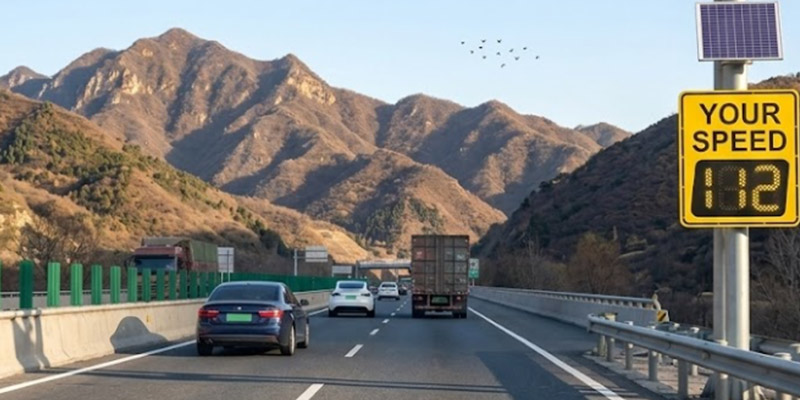
The core operating principle of radar speed signage is based on the Doppler effect of microwave radar. Through four closed-loop processes—radar sensing, data processing, intelligent decision-making, and visual display—it achieves precise speed measurement and intelligent warnings, providing stable speed data output around the clock, unaffected by lighting, weather, or traffic flow.
Step 1: Transmission and Reception of Radar Microwave Signals. The device is equipped with a high-precision microwave radar sensor that continuously transmits high-frequency microwave signals toward the front of the lane. When a vehicle enters the detection zone, the microwave signal reflects off the vehicle’s body, creating a reflected echo. The sensor rapidly receives this reflected signal—with a response time measured in milliseconds—to accurately capture the driving status of passing vehicles. The effective detection range extends up to 300 meters, making it suitable for multi-lane roads and various road conditions at both high and low speeds.
Step 2: Intelligent chip accurately calculates vehicle speed. Based on the Doppler effect, the system uses built-in algorithms to precisely calculate the vehicle’s real-time speed based on the time difference between the transmitted microwave signal and the echo, as well as the frequency shift. Speed measurement error is controlled within ±2 km/h, with accuracy far exceeding that of ordinary speed measurement devices. It effectively avoids interference from non-motorized vehicles, pedestrians, and debris, eliminating false positives and false alerts.
Step 3: The intelligent system compares data and triggers tailored alerts. The device’s mainboard stores predefined speed limits for specific road segments and automatically compares real-time vehicle speed against these thresholds, creating a dual-alert logic: When the vehicle is traveling within the speed limit, the screen displays the speed in green or white, providing a gentle reminder of the current speed; when the vehicle is speeding, the system immediately triggers a bright, flashing red alert to create a strong visual impact, compelling the driver to slow down promptly. Additionally, the device is equipped with light-sensing and temperature-control modules that automatically increase screen brightness during the day to counteract glare from strong sunlight and automatically reduce brightness at night to prevent glare, adapting to different operating conditions day and night.
Step 4: Dual-power system ensures continuous operation. HOAN radar speed sign models are available in two operating modes: mains power and solar power. The grid-powered model relies on a stable 24-hour power supply from the municipal grid, making it impervious to extreme weather and suitable for urban arterial roads and highway sections with heavy traffic. The integrated solar-powered model uses photovoltaic panels to store energy during the day and a lithium battery to supply power at night, requiring no wiring and incurring zero electricity costs. It is perfectly suited for rural roads, remote scenic areas, and mountainous sections without grid coverage, enabling all-weather, unattended operation.
Step 5: Fully Sealed Protection Ensures All-Weather Operation. The device features an IP66-rated, fully sealed, waterproof, and dustproof housing paired with a corrosion-resistant aluminum alloy casing. It can withstand torrential rain, intense sunlight, sandstorms, frost, and coastal salt fog corrosion. The internal core components—including the radar, motherboard, and display—remain unaffected by external environmental factors, ensuring accurate speed measurement and stable operation in rain, snow, heavy fog, and extreme temperatures.
HOAN Traffic has optimized the device’s hardware configuration to address complex global road conditions, ensuring speed measurement accuracy, stability, and service life at the core component level. This sets it apart from ordinary, low-end products on the market and makes it suitable for various high-standard municipal and overseas engineering projects.
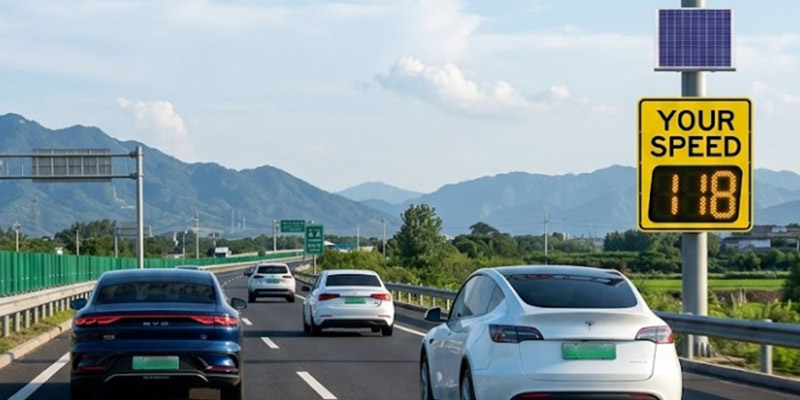
By considering the traffic flow characteristics, regulatory requirements, and power supply conditions of different road types, HOAN matches product models specifically to each scenario, ensuring precise implementation and maximizing the effectiveness of speed warning systems.
Campus and Residential Area Roads: With mixed pedestrian and vehicle traffic, strict speed controls, and the need for low-light warnings at night, we recommend compact solar-powered radar speed sign. With no wiring required and no electricity costs, these signs feature soft lighting that does not disturb residents while providing precise speeding alerts, effectively reducing the rate of speeding-related accidents in residential areas and on campus.
Major urban thoroughfares and urban expressways: With heavy, dense traffic and round-the-clock traffic flow, high-power, mains-powered radar speed display signs are the preferred choice. Offering long-range speed detection, rapid response, and high-intensity warnings, they operate stably 24 hours a day, making them ideal for managing high-frequency urban traffic.
Highway ramps, toll plazas, and service area sections: With high vehicle speeds and a high incidence of accidents, these areas require early warnings from a distance; large-size, cast-aluminum, mains-powered speed detection signs are recommended. The radar detection range is adjustable, and the housing is sturdy and impact-resistant, making them suitable for heavy highway traffic and complex road conditions.
Rural roads and remote scenic areas without grid power: Due to a lack of power supply and limited maintenance capabilities, integrated solar-powered radar speed display signs are recommended. They require no excavation or wiring, have ultra-low maintenance costs, and provide long-term use with a single installation, solving the challenge of speeding control on remote road sections.
Industrial parks and factory premises: With mixed traffic of trucks and non-motorized vehicles requiring routine speed limit enforcement, medium-sized solar-powered speed display signs are the ideal choice. Offering outstanding value for money, they are suitable for large-scale deployment to regulate traffic order within the premises.
Compared to traditional road speed enforcement equipment, radar speed display signs offer significant advantages in terms of practicality and cost-effectiveness. Compared to fixed electronic speed-capture devices, they require no complex wiring or civil engineering work, are less expensive, and feature extremely simple operation and maintenance. Since they do not issue fines based on captured images, they are more readily accepted by drivers and are suitable for large-scale, widespread deployment. Compared to static speed limit signs, real-time visual feedback on vehicle speed effectively combats driver visual fatigue, proactively curbing speeding behavior and improving speed reduction effectiveness by over 80%; Compared to manual speed measurement, these devices enable 24-hour fully automated, unattended operation, unrestricted by time or weather, significantly reducing labor costs for traffic control. They are a core component of lightweight upgrades for modern smart transportation systems.
To ensure effective performance and a long service life, equipment selection during project procurement must be tailored to specific operating conditions: In urban areas with heavy traffic, prioritize models powered by the municipal power grid to ensure stable, all-weather operation; In remote areas without power lines, opt for integrated solar-powered models to reduce construction and O&M costs; in rainy or coastal areas prone to salt fog, be sure to select IP66-rated waterproof and corrosion-resistant aluminum alloy models to prevent water ingress and corrosion-related failures; in school campuses and residential areas, prioritize soft-light, anti-glare models to avoid disturbing residents with intense light at night. For overseas project procurement, choose HOAN’s source factory, which provides a full suite of international certifications, installation drawings, commissioning guidance, and after-sales warranty services to ensure smooth project acceptance.
Radar speed detection signs rely on a comprehensive operational system featuring microwave radar detection, intelligent data processing, LED visual warnings, and dual-mode power supply, addressing the industry pain points of traditional road speeding control—low efficiency, high costs, and numerous blind spots. With core advantages such as precise speed measurement, all-weather operation, low O&M costs, and adaptability to all scenarios, these signs are widely used in various settings—including urban and rural roads, school campuses, highways, and industrial parks—making them essential equipment for enhancing road safety and achieving refined, smart traffic management.
To learn more about HOAN radar speed detection signs—including specifications, project case studies, customized selection plans, and bulk purchase quotes—visit the official HOAN website at haroadstud.com. You can request free samples and connect with our professional technical team to obtain a tailored road management solution.