
During a 2023 fire drill at a shopping mall, test data simulating a “dense smoke environment” revealed alarming statistics: In areas without standardized exit signage, the average evacuation time reached 8 minutes and 20 seconds, with 30% of people becoming disoriented and making “ineffective backtracking.” Conversely, in areas with clear exit signage, evacuation time dropped to 1 minute and 45 seconds, with no instances of misjudged direction.
In emergencies like fires, earthquakes, or sudden power outages, panic rapidly erodes rational judgment. Complex building structures become labyrinths, and traditional text-based signage is easily obscured by smoke. Only exit signs can pierce the chaos, serving as vital “visual anchors” guiding people to safety.
Most people equate exit signs with “signs labeled ‘Exit’,” overlooking their underlying safety logic. In reality, compliant exit signs are systemic facilities integrating “directional guidance, emergency illumination, and risk warning.”
Their purpose extends beyond everyday spatial navigation to serve as lifeline guides during emergencies. Their significance transcends mere “signage function,” making them an indispensable core component of building safety.
According to the Code for Fire Protection Design of Buildings (GB 50016-2014), exit signs are “specialized fire safety markings indicating the location, direction, and evacuation routes of building exits.” They carry explicit statutory enforceability—all public buildings and densely populated venues must install them according to standards or fail fire safety inspections.
Their core mission is to ensure occupants can swiftly and accurately identify evacuation exits under any conditions, buying critical time for safe escape.
Classified by Display Method:
By Installation Location:

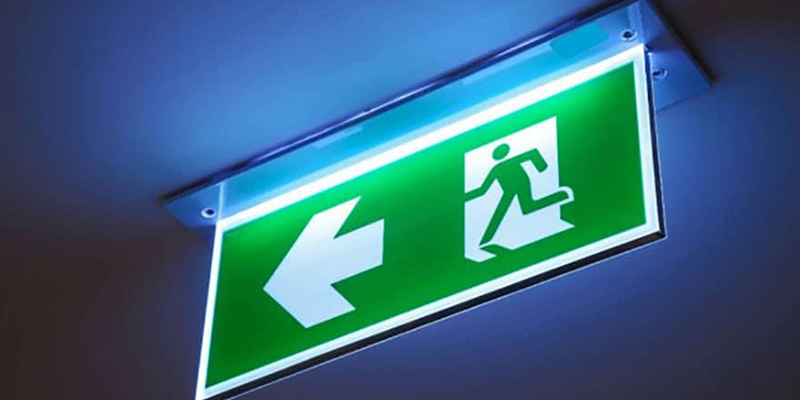
Modern building structures grow increasingly complex. Circular circulation paths in shopping malls, multi-zone layouts in hotels, and split-level offices often lead occupants to experience “spatial disorientation.” Exit signs overcome language and cultural barriers through standardized graphics—green background + white running figure + arrow—enabling rapid recognition by seniors, children, and visitors alike.
For instance, in large shopping malls, exit signs placed every 50 meters form a “guidance chain” through their arrow directions. Even first-time visitors can follow these signs to find the nearest exit, avoiding anxiety and confusion caused by getting lost.
Adaptability in Extreme Scenarios
During fires, dense smoke obscures vision, rendering ordinary signage instantly useless. High-quality exit signs, equipped with LED high-brightness light sources or self-luminous materials, can penetrate 3-5 meters of smoke with visibility exceeding 30 meters, creating a “visual corridor” for people. In sudden power outages, built-in backup batteries immediately activate, ensuring continuous illumination and preventing panic-induced stampedes in darkness.
Guiding Orderly Evacuation
Beyond directional guidance, exit signs incorporate auxiliary markings like “No Return” and “Priority Evacuation.” In multi-exit buildings, differentiated signage (e.g., “Left Exit → Fire Stairwell,” “Right Exit → Outdoor Plaza”) enables rapid crowd diversion, preventing congestion at single exits and significantly boosting evacuation efficiency.
In 2024, an office building suffered two injuries during a minor fire due to damaged exit signs that were not promptly replaced. The property management not only bore medical compensation costs but also faced a 50,000 yuan fine from fire authorities and was placed on a priority safety hazard monitoring list.
The installation and maintenance of exit signage directly impact corporate and property management safety liabilities. Standard-compliant exit signs serve as both a “passport” for fire safety inspections and a “shield” against legal accountability post-incident, reflecting commitment to life safety and corporate social responsibility.
In venues like shopping malls, cinemas, and stadiums, peak-hour crowd density can reach 3-5 people per square meter, with attendees often unfamiliar with the environment. Exit signage must achieve “360° seamless coverage,” with continuous placement at critical junctures such as corridor corners, escalator sides, and theater entrances.
For instance, during cinema intermissions, brightly lit exit signs swiftly direct crowds toward separate exits. After sporting events, floor-level exit guides prevent audience congestion in passageways, ensuring orderly crowd dispersal.
In high-rise structures like office towers and hotels, evacuation routes are lengthy and multi-faceted. Exit signage must integrate with stairwell indicators and floor identifiers to form a coordinated system. At stairwell entrances, signs clearly state “Exit to 1st Floor via 3rd Floor Stairs”; near elevator lobbies, supplementary “No Elevator Use” indicators guide occupants toward safe routes.
Some premium hotels integrate “XX floors above ground” indicators into exit signs, alleviating panic during vertical evacuation and enhancing cooperative escape efforts.
Premium exit signs must pass the Compulsory Certification for Fire Protection Products (CCCF certification) and comply with the “Fire Emergency Lighting and Evacuation Indication System” standard (GB 17945-2010). When purchasing, verify the product's certification certificates and test reports to avoid using uncertified products that pose safety hazards.
Fire department inspection data reveals that 60% of exit sign failures stem from inadequate routine maintenance. Dust accumulation reduces brightness, while battery degradation compromises emergency runtime. The correct approach involves monthly checks of the signs' illumination status and biannual testing of emergency functions to ensure they perform reliably when critical.
Some venues, seeking uniform decor, replace standard exit signs with colorful or artistic designs, resulting in blurred graphics and non-compliant colors. This not only violates fire regulations but can mislead evacuation directions during emergencies. Strict adherence to the standard “green background + white graphic” format is mandatory.
The core function of exit signs is to “form a continuous guidance chain,” not to exist in isolation. Continuous signage must be installed at key points such as long corridors (over 20 meters), intersections, and staircase turns. This ensures visibility from any location along the evacuation route, preventing disorientation during emergencies.
Every detail of an exit sign relates to life safety. It stands silently in daily life but becomes the most reliable “beacon of life” in times of crisis. It is not only a compliance requirement for building safety but also a direct reflection of corporate and property management social responsibility.
Whether planning signage for new projects or upgrading safety in older facilities, selecting compliant, reliable exit signs is paramount. With over a decade of expertise in traffic safety and fire safety signage, we provide comprehensive exit sign solutions: from site surveys and customized layout design to CCCF-certified product supply and ongoing maintenance inspections—all backed by professional support throughout.
If you're facing challenges with exit sign selection, installation, or upgrades, we invite you to contact us. Let our professional products and services transform every exit sign into a truly reliable “life guide,” fortifying your premises with a robust safety defense.