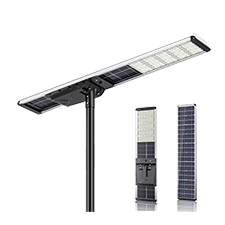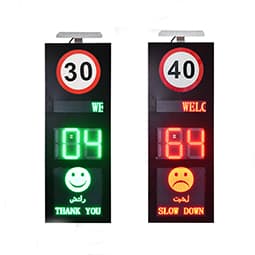

Under the global trend of energy conservation and intelligent transformation, solar street lamps have become the core choice for upgrading road lighting in various countries due to their advantages such as energy conservation and environmental protection, self-powered supply, and easy installation. Whether it is the renovation of urban main roads, the full coverage of rural lighting, or the infrastructure construction in remote areas, the demand for solar street lamps is continuously surging.
China holds a significant advantage in the solar street lamp industry: it has a complete industrial chain from core component research and development to finished product production, mature manufacturing technology, outstanding product cost performance, and at the same time possesses strong technological research and development capabilities. Data shows that China's solar street lamp exports have consistently ranked among the top in the world, accounting for over 60% of the global market share. Domestic policies such as the "dual carbon" goals and the rural revitalization lighting project have also continuously injected impetus into the development of the industry.
When global purchasers and domestic engineering parties choose solar street lamp suppliers, they often encounter many pain points: the product quality varies greatly, the standards of core components are not transparent, some suppliers have delivery delays, insufficient after-sales technical support, and even there is a risk of intellectual property infringement. All these may lead to project cost overspending and progress delays.
Choosing top-notch suppliers can effectively avoid these risks: top-notch suppliers have stable product quality control systems, reliable large-scale supply capabilities, professional customized solutions, and comprehensive full-process after-sales services. Cooperating with them not only ensures the quality and efficiency of project delivery but also enhances the overall competitiveness of the project by leveraging their technological advantages.
R&d capability is the core of a supplier's technological competitiveness. Top suppliers usually have professional R&D teams. Most of the team members have accumulated many years of technical experience in the lighting industry and hold multiple invention and utility model patents. Some of them have also established cooperation with universities and research institutions to continuously promote technological innovation.
The scale of manufacturing is as crucial as the process. Attention should be paid to the area of the supplier's production base, the configuration of the automated production line and the annual production capacity to ensure that they can meet the demands of large-scale procurement. In addition, a complete quality control process (such as IQC incoming material inspection, IPQC process inspection, and FQC finished product inspection) is the foundation for ensuring product consistency. Top suppliers all strictly follow international manufacturing standards.
The quality of core components directly determines the service life and performance stability of solar street lamps. Top suppliers strictly control the selection of components: solar panels give priority to monocrystalline silicon or polycrystalline silicon products with a conversion efficiency of ≥20%, batteries use large-capacity and long-cycle life brand lithium iron phosphate batteries, and LED light sources ensure high brightness, high color rendering index and low light attenuation.
The product performance needs to meet the requirements of diverse scenarios: the water and dust resistance grade should not be lower than IP65, and it should have excellent wind resistance, pressure resistance and low-temperature resistance. The continuous lighting capacity on rainy days should reach 7 to 15 days. Meanwhile, the products must pass authoritative international and domestic certifications such as CE, RoHS, FCC, and ISO9001, and be able to provide complete test reports on light efficiency, lifespan, safety, etc.
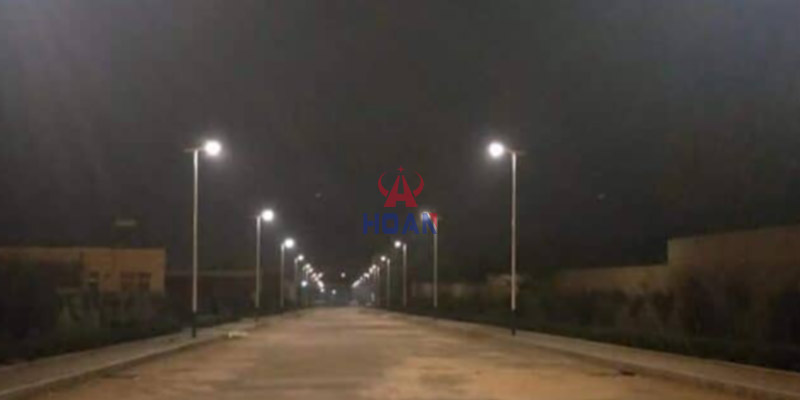
In terms of pre-sale services, top suppliers are equipped with professional consulting teams that can tailor lighting solutions based on the application scenarios (such as different climates and road types) and performance requirements of the purchasers, and provide samples for testing and verification.
During-sale services focus on transparency and flexibility: real-time tracking of production progress, timely feedback of progress to the purchaser, and provision of phased quality inspection reports; It simultaneously supports multiple delivery terms such as FOB, CIF, and DDP, adapting to the logistics requirements of different procurement scenarios.
After-sales service is the key to cooperation guarantee: Top suppliers clearly commit to the warranty period for the entire machine and core components (usually core components are guaranteed for more than 5 years and the entire machine for more than 2 years), provide on-site installation guidance and technical training services, respond promptly to faults, and can quickly offer maintenance support and spare parts supply.
Market coverage is a direct manifestation of a supplier's strength. The products of top suppliers not only sell well in various provinces and cities across the country, but are also exported to many regions such as Europe, North America, Southeast Asia and Africa, and have a stable customer base in the core global markets.
Cooperation cases can better verify its service capabilities: Focus on whether the supplier has cooperation experience with large engineering enterprises, government departments, and well-known multinational companies, and whether it has participated in benchmark projects such as large-scale municipal lighting and rural revitalization lighting. In addition, a good industry reputation is indispensable. The purchaser can verify through channels such as customer reviews, industry awards, and media reports, and give priority to suppliers without major quality disputes or negative records.
Technological innovation capability is the core driving force for the continuous development of suppliers. Top suppliers are actively laying out smart lighting technology, promoting the integration of solar street lamps with the Internet of Things and AI technologies to achieve intelligent functions such as remote monitoring, automatic dimming sensing, and automatic fault diagnosis.
In terms of sustainable development, top suppliers use environmentally friendly materials and energy-saving production processes, and strictly abide by environmental protection policies. At the same time, it supports flexible cooperation models such as OEM/ODM, batch customization, and long-term strategic cooperation, which can better adapt to the personalized demands of different purchasers.
Basic Information: Founded in 2010, its headquarters is located in Shenzhen, Guangdong Province. It has two major production bases in Zhongshan and Zhejiang, covering a total area of over 100,000 square meters, with an annual production capacity of more than 500,000 sets.
Core advantages: The R&D team consists of over 50 people and holds more than 80 technical patents, leading in the fields of intelligent control and high-efficiency energy storage. Our product range is complete, covering dedicated solar street lights for all scenarios such as urban main roads, rural roads, scenic spots, and construction sites. We have established after-sales service outlets in over 20 countries around the world, capable of providing 7× 24-hour multilingual technical support.
Representative cases: Intelligent transportation lighting renovation projects in multiple provincial capital cities in a certain country, a full coverage project of rural lighting in a certain African country, and smart city supporting lighting projects in Southeast Asia.
Cooperation highlights: We offer a one-stop service covering "solution design - product customization - installation guidance - post-operation and maintenance". The delivery cycle for large-scale orders can be shortened to 15-20 days, meeting the urgent needs of large-scale projects.
Basic Information: Headquartered in Zhengzhou, Henan Province, we have been deeply engaged in the lighting industry for 13 years. We have 3 fully automatic production lines with an annual production capacity of 800,000 sets. The core team members all come from leading enterprises in the industry.
Core advantages: Relying on the complete lighting industry cluster advantages, it realizes independent matching of core components and strictly controls production costs. The product focuses on the mainstream demands of the general public, with stable quality and outstanding cost performance. The core components are all selected from well-known brands in the industry and have passed multiple authoritative certifications.
Representative cases: Lighting projects for rural revitalization in multiple provinces across China, road renovation projects in small and medium-sized cities in Southeast Asia, and bulk procurement projects in large domestic parks.
Cooperation highlights: For bulk purchases, we offer stepped preferential prices, support flexible payment terms, and have a short sample delivery cycle (3-5 days), making it suitable for small and medium-sized purchasers and budget-sensitive projects.
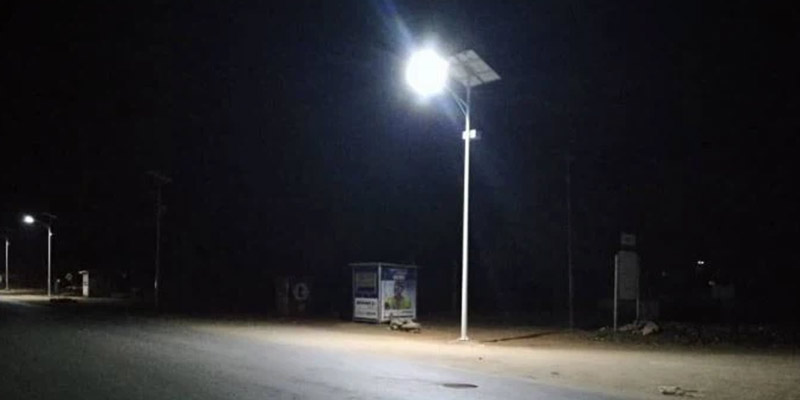
First, it is necessary to clearly define the core requirements: clearly define the lighting application scenarios (road types, traffic flow), key performance indicators (brightness, battery life on rainy days), procurement budget, delivery time nodes and after-sales technical support requirements.
Multi-channel supplier screening: Supplier information can be collected through industry exhibitions (such as the Guangzhou Light Fair and the Shanghai International Lighting Fair), B2B procurement platforms, recommendations from industry associations, and referrals from peer customers. During the initial screening, the focus is on verifying the enterprise's qualifications, core certifications, and representative cases. Through initial communication, their professionalism and response speed are evaluated.
Emphasize sample testing: Request samples from potential suppliers, entrust third-party authoritative institutions or conduct performance tests independently, focusing on verifying core indicators such as luminous efficiency, waterproof performance, and sensing function to confirm that the product meets the requirements.
Refine the contract terms: When signing a formal contract, clearly define key contents such as product parameters, quality standards, delivery time, payment methods, definition of quality responsibilities, and scope of after-sales guarantees to avoid subsequent disputes.
Strengthen production monitoring: For large-scale purchase orders, dedicated personnel can be arranged to conduct on-site inspections of the production process, or a third-party quality inspection agency can be entrusted to carry out on-site supervision to ensure that the production process complies with quality standards and guarantees the delivery schedule.
Strict inspection upon receipt: After receiving the goods, promptly verify the quantity, check if the product appearance is intact, take samples to verify if the product performance is consistent with the contract agreement, and communicate and handle any problems with the supplier in a timely manner.
Make efficient use of after-sales resources: If technical problems are encountered during installation and commissioning, contact the supplier in a timely manner for guidance. In the event of product quality issues, the after-sales repair process will be initiated in accordance with the contract to ensure the smooth progress of the project.
Maintain long-term cooperation: For suppliers with a good cooperative experience, a long-term strategic cooperative relationship can be established. Long-term cooperation not only enables one to obtain more favorable purchase prices and flexible cooperation terms, but also allows priority access to the new technologies and product resources of suppliers.
The intelligent upgrade is accelerating: In the future, solar street lamps will deeply integrate Internet of Things, AI and big data technologies to achieve more precise remote monitoring, automatic fault diagnosis, traffic flow perception and other functions, and become an important part of the intelligent transportation system.
Breakthroughs in high-efficiency and energy-saving technologies: Suppliers will continue to develop solar panels with higher conversion efficiency and longer-life energy storage batteries, optimize energy management algorithms, further enhance the energy utilization efficiency of products, and reduce energy consumption.
The orientation towards sustainable development is clear: More and more suppliers will adopt environmentally friendly and recyclable materials, promote low-carbon production processes, and pay more attention to the environmental friendliness of the entire life cycle in product design, which is in line with the global green development concept.
Scenario-based product segmentation: In response to the specific demands of various industries (such as culture and tourism, industry, and agriculture) and different regional environments, suppliers will launch more targeted specialized products, and the scenario adaptation capabilities will continue to improve.
The demand in emerging markets has exploded: The power grid infrastructure in regions such as Southeast Asia and Africa is not well developed, and the demand for solar street lamps has continued to grow, providing a vast market space for purchasers and creating more opportunities for cooperation with Chinese suppliers.
Policy-driven market expansion: The continuous advancement of domestic policies such as rural revitalization, new urbanization, and smart city construction, as well as the introduction of energy conservation and environmental protection policies by many overseas countries, will directly boost the demand for solar street lamps.
The demand for high value-added products is on the rise: With the advancement of intelligent transportation and smart park construction, the procurement demand for high value-added solar street lamps with functions such as intelligent linkage and adaptation to special environments will continue to increase. Cooperating with top suppliers with core R&D capabilities will make the market more competitive.
China's solar street light industry, with its complete industrial chain, mature manufacturing technology and strong innovation capabilities, has become an important force in the global lighting industry. China's top suppliers have significant advantages in R&D, manufacturing, quality and service, and can provide high-quality and cost-effective products and professional solutions for global purchasers and domestic engineering parties.
For the purchasing party, only by following scientific screening criteria, locking in top suppliers that are suitable for their own needs, and doing a good job in quality and progress control throughout the procurement process can efficient cooperation be achieved. In the future, as the industry upgrades towards intelligence and greenness, Chinese solar street lamp suppliers will continue to introduce more competitive products and services.
We sincerely invite global purchasers, domestic engineering parties and China's top solar street lamp suppliers to cooperate deeply, join hands to promote the energy-saving and intelligent development of the global lighting industry, and jointly build a safe, efficient and green lighting ecosystem. If you have purchasing needs, you can connect with high-quality suppliers through formal industry channels to embark on a precise cooperation journey.