Security issues often strike unexpectedly in daily operations and life. A street-front shop suffered two consecutive thefts within a month due to lacking surveillance warnings, losing cash from the register and valuable merchandise—direct losses exceeding 12,000 yuan. A residential complex faced repeated complaints over unidentified perpetrators in high-altitude object-throwing incidents because elevators and parking lots lacked surveillance notices. A construction site endured frequent material thefts from unmonitored storage areas, with quarterly losses reaching 50,000 yuan.
The core commonality in these cases is the neglect of the security value of “preemptive warnings.” Many mistakenly believe that “installing surveillance equipment solves everything,” overlooking the critical role of deterrence in risk prevention.
The 24-hour surveillance sign is far more than a simple “text label.” It represents a comprehensive security system encompassing “pre-incident prevention, real-time control, and post-incident traceability.” Through its visual warning, it conveys the core message of “behavioral traceability.” Its value extends beyond mere reminders—it fundamentally reduces risks at the source, defines accountability, and enhances management efficiency.
Today, we delve into the core functions of 24-hour surveillance signage to explore how it serves as an “invisible security guardian” across diverse scenarios.
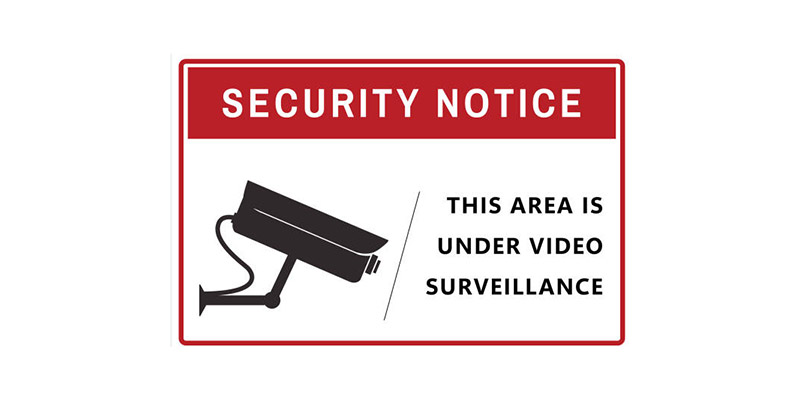
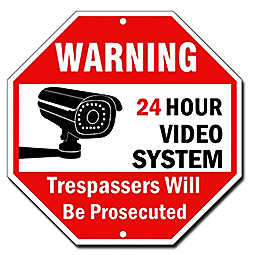
From a professional perspective, the 24-hour surveillance sign is a legally mandated warning identifier used to explicitly notify individuals that a specific area is under continuous video surveillance. It must comply with relevant standards such as the “Safety Signs and Their Usage Guidelines.” It possesses clear warning efficacy, serving both as a deterrent against potential risky behavior and as public proof of security measures in place.
(1) By Installation Method
Suspended signs suit elevated areas like storefronts and office corridors, offering wide visibility and broad warning coverage. Wall-mounted signs are ideal for vertical surfaces in elevator lobbies, stairwells, and office entrances, saving space and minimizing damage risks. Freestanding signs are commonly used in open outdoor settings such as construction site entrances, parking lots, and residential perimeter walls, allowing flexible relocation.
(2) By Material and Craftsmanship
Metal Reflective: Combines engineering-grade reflective film with cold-rolled steel plate. Clearly visible within 50 meters under nighttime illumination, suitable for outdoor nighttime scenarios. Acrylic Screen-Printed: Lightweight, easy to install, and vibrantly colored. Ideal for indoor ambient temperature environments like shopping malls and supermarkets. Corrosion-Resistant Stainless Steel: Features exceptional wind load resistance, UV protection, and corrosion resistance. Suitable for harsh environments such as coastal areas, construction sites, and open-air parking lots.
(3) Functional Add-On Classification
The Basic model features standardized warning text and surveillance icons, meeting standard warning requirements. The Smart model incorporates a “dynamic surveillance indicator light” that simulates camera activity for enhanced deterrence. The Enhanced model integrates with alarm systems, triggering simultaneous audio-visual alerts when individuals approach sensitive areas, further strengthening control measures.
This represents the most direct and fundamental value of 24-hour surveillance signage. For potential thieves, vandals, or troublemakers, the clear “24-Hour Video Surveillance in Effect” designation signifies that their actions will be fully recorded. These records can serve as legal evidence for accountability, instilling a strong psychological sense of apprehension.
Authoritative Data Support: After a commercial district organized 30 shops to uniformly install standardized surveillance signs, shoplifting incidents in the area dropped from 15 per month to 4 per month within just one month—a 72% reduction. In a residential parking lot, after posting the signs, hit-and-run incidents involving vehicle scrapes decreased from 8 per month to 2 per month, a 68% reduction.
At junctions between public and private areas, hazardous zones, and similar scenarios, 24-hour surveillance signage serves as “critical evidence for defining responsibility.” For instance, signage at residential complex entrances clearly informs outsiders: “This area is under surveillance. Compliance with community regulations is required.” In hazardous zones like construction sites or high-voltage electrical rooms, signage warns non-workers: “No entry. Enter at your own risk.”
In the event of an accident, these signs demonstrate that management fulfilled their “duty to provide clear warnings.” For instance, when a visitor sustained injuries after mistakenly entering an equipment room in an office building, the presence of a “Surveillance in Effect + No Entry” sign at the entrance successfully established the visitor's primary liability, thereby shielding management from unnecessary losses.
While surveillance equipment is central to post-incident evidence gathering, 24-hour monitoring signs further strengthen the legitimacy and validity of such evidence. Relevant laws mandate that installing surveillance in public areas or business premises requires prior explicit notification to relevant parties. These signs serve as direct proof that the “duty to inform” has been fulfilled.
In practical dispute resolution, signage also plays a crucial role. For instance, in disputes between shops and customers over damaged goods where customers claim “damage occurred through no fault of their own,” the shop's surveillance signage can demonstrate that “the consumption area is under surveillance,” guiding customers to cooperate in retrieving footage to swiftly clarify responsibility. When property management and owners dispute vehicle scrapes, parking lot surveillance signage directly corroborates the validity of surveillance records, accelerating dispute resolution.
In high-traffic areas like corporate campuses, schools, and hospitals, 24-hour surveillance signage creates an “invisible management constraint.” Employees, aware of monitoring, voluntarily adhere to attendance policies and operational standards, reducing tardiness, early departures, and unsafe practices. Students, patients, and visitors also proactively maintain public order, minimizing incidents like disorderly conduct or vandalism.
For administrators, signage significantly reduces manual patrol demands. After installing surveillance signs throughout workshops, warehouses, and office buildings, one factory decreased manual patrols by 40% while reducing violations by 55%, markedly improving management efficiency.
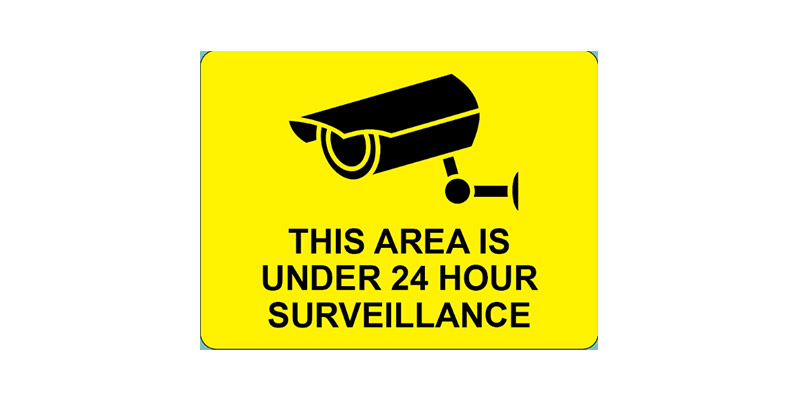
For retail spaces like shops, supermarkets, malls, and convenience stores, core needs include preventing merchandise theft, cashier risks, and consumer disputes. Installing surveillance signage at entrances, cash registers, high-value merchandise zones, and blind spots directly deters theft and reminds customers to secure personal belongings.
Especially in high-risk venues like night-operating convenience stores and gas stations, the “24-hour surveillance” notice significantly reduces the likelihood of serious crimes such as violent robberies and malicious vandalism. After a chain convenience store brand uniformly installed reflective surveillance signs across its nationwide locations, nighttime theft and robbery incidents decreased by 63%.
Residential complexes, apartments, and villa communities face core challenges like objects being thrown from heights, vehicle collisions, unauthorized intruders, and property theft. Placing surveillance signs in key areas—elevator lobbies, stairwells, parking lots, perimeter walls, and building entrances—clearly signals “comprehensive security coverage,” enhancing residents' sense of safety.
For property management, these signs also serve as a visible demonstration of “adequate security measures.” After one residential complex comprehensively installed surveillance signs and upgraded its monitoring equipment, resident satisfaction scores rose from 65 to 88 points, with complaints decreasing by 70%.
(1) Office Buildings and Corporate Facilities
Core purposes include regulating employee conduct, protecting trade secrets, and addressing labor disputes and property damage. Signage in office areas, archives, R&D workshops, and material storage zones reminds staff to comply with regulations while preventing risks like confidential information leaks and material loss.
(2) Schools and Hospitals
Schools prioritize preventing bullying, student safety incidents, and unauthorized access; hospitals focus on mitigating medical disputes, theft, and patient wandering. Surveillance signage in school corridors, playgrounds, outpatient buildings, inpatient wards, and parking lots effectively regulates behavior and provides evidence support for emergency response.
(3) Government Agencies & Subway Stations
As highly populated public areas, the core need is to strengthen public order management and deter illegal activities. Placing signage at entry security checkpoints, lobbies, and passageways reminds the public to follow regulations while providing robust support for handling emergencies like terrorist attacks or public disturbances.
At hazardous sites like construction zones, factory workshops, high-voltage electrical rooms, and chemical warehouses, surveillance signage serves dual purposes: security protection and safety operation reminders. Beyond preventing material loss and unauthorized entry, it alerts workers to adhere to safety protocols—such as wearing protective gear and prohibiting unauthorized operations.
After installing corrosion-resistant stainless steel surveillance signs in crane operation zones, building material storage areas, and hazardous chemical storage zones at a construction site, unauthorized operations decreased by 60%, and incidents of building material loss were completely eliminated.
(1) Visibility is Paramount
Text and graphics must be concise, eye-catching, and unambiguous. Prioritize standardized designs featuring “CCTV camera symbols + ‘24-hour video surveillance’ text.” Outdoor models must use engineering-grade or higher reflective film to ensure clear visibility within 50 meters under nighttime lighting. Indoor models require vivid colors for rapid recognition in low-light environments.
(2) Durability Determines Lifespan
Outdoor models must resist corrosion, UV exposure, wind loads, and impacts. Enclosures should prioritize 304 stainless steel or thickened acrylic materials to ensure ≥5 years of service life in harsh conditions like heavy rain, snowstorms, high temperatures, and coastal high-salt fog environments. Indoor models require wear-resistant, easy-to-clean surfaces to prevent blurring from human contact or wiping.
(3) Adaptability Meets Diverse Needs
Dimensions must support customization, with appropriate specifications selected based on installation space (standard sizes: 30cm×40cm, 40cm×60cm, 50cm×70cm). Installation methods must be flexible and diverse, supporting screw mounting, strong adhesive bonding, suspension, and other forms to accommodate different wall surfaces, elevated locations, and ground-level scenarios.
Text content, graphic designs, and placement locations must strictly adhere to the “Safety Signs and Their Usage Guidelines” (GB 2894-2008) and local security facility regulations. For instance, text must use standard Simplified Chinese characters, and graphics must comply with national standard symbols. This prevents “invalid warnings” due to non-compliant signage or compromised evidence validity in disputes caused by non-conforming labels.
Correction: Surveillance equipment primarily serves “post-incident evidence collection,” while signage functions as “preemptive deterrence.” Both complement each other and are indispensable. Without signage, potential offenders may commit violations due to lack of awareness. Furthermore, in certain scenarios, the legality of surveillance evidence collected without prior notification may be questioned.
Correction: Handwritten notes or homemade signs fade easily, get damaged, and lack visual impact. Not only do they fail to provide effective deterrence, but they also risk being used as an excuse to avoid responsibility by claiming “clear warnings were not visible.” Professional signage is engineered for “effective warning” through its materials, design, and craftsmanship. Its standardized appearance and durability cannot be replaced by makeshift alternatives.
Correction: Signs must be strategically placed at critical points—entrances, corners, high-value areas, hazardous zones—where excessive density causes “visual fatigue” and warning neglect. Avoid obstructed or vulnerable locations to ensure long-term visibility.
A small 24-hour surveillance sign embodies comprehensive security value—preventing incidents before they occur, managing them during, and enabling post-event traceability. It serves as a psychological deterrent against unlawful acts, a legal proof of responsibility, an invisible assistant for enhanced management efficiency, and a core barrier safeguarding property and personnel. .
Whether for commercial operations, residential areas, public management, or specialized work sites, selecting compliant, reliable 24-hour surveillance signs represents a cost-effective choice for elevating security levels and mitigating risks. With over a decade of expertise in developing and manufacturing warning signage, we understand diverse security needs across scenarios and offer comprehensive solutions: From material selection (reflective/corrosion-resistant/smart options) and customized design (dimensions/text/graphics) to professional installation guidance and after-sales maintenance, we safeguard your security throughout the entire process.
If you're seeking premium surveillance signs for upgrading your premises' security, we welcome your inquiry. Let every surveillance sign become a true “guardian of safety,” fortifying the first line of defense for your property and personnel.