Community sidewalks are the primary pathways residents use for daily walks, commuting, and leisure activities. The comfort, safety, and reliability of sidewalk lighting directly impact the residential experience and the level of community security. Currently, a large number of both new and older residential communities face common shortcomings in walkway lighting: in older communities, electrical circuits are aging, and the cost of rewiring and renovation is extremely high; in newly built communities, lighting systems are simplified to control budgets, leading to a series of problems such as dimly lit walkways at night, glare that disturbs residents, persistently high electricity bills, and frequent lamp failures. Traditional grid-connected streetlights rely on municipal power supply, buried wiring, and regular maintenance, which not only increases the property management’s operational burden but also frequently leads to resident complaints and safety hazards such as tripping and collisions.
Amid the trend toward streamlined lighting upgrades in communities, solar streetlights have emerged as the mainstream solution for enhancing community walkway illumination, thanks to their core advantages: no wiring required, zero electricity costs, glare-free lighting, low maintenance costs, and all-weather durability. HOAN Traffic specializes in the R&D of residential and municipal lighting equipment. We have developed a full range of integrated solar street lights specifically designed for residential walkways, suitable for various projects such as the renovation of older neighborhoods, lighting upgrades for new communities, and renovations in coastal areas with high rainfall. This article provides an in-depth analysis of the pain points associated with traditional community walkway lighting and details the practical value, implementation advantages, and specific selection solutions of solar street lights in community settings, offering professional guidance for community property management, general contractors, and infrastructure procurement for overseas residential areas.
Most residential communities have relied on traditional grid-powered lighting systems for many years, which are no longer capable of meeting the modern community’s needs for lighting, energy efficiency, and living experience. There are four core renovation challenges, which are also the key pain points in current community infrastructure upgrades.
First, renovating older communities is costly and technically challenging. In older communities, underground utility lines are intricately intertwined, and the pavement is fully paved. Upgrading traditional streetlights requires excavating the pavement, laying cables, and installing distribution boxes. This not only results in lengthy construction periods and significant disruption to residents but also damages the community’s pavement and landscaped areas. The overall project cost is exorbitant, making it unaffordable for most property management companies. In newly built communities without pre-installed utility lines, the additional installation of grid-powered lighting circuits also substantially increases the infrastructure budget.
Second, long-term operating costs remain persistently high. Community walkway lights must remain on all night, year-round. Traditional grid-powered streetlights consume a great deal of electricity, resulting in high monthly electricity bills. At the same time, aging wiring, water ingress into fixtures, and frequent short-circuit failures require property management to assign dedicated staff for regular inspections, repairs, and replacements. The labor and material costs for maintenance accumulate year after year, becoming a long-term financial burden on the community’s operations.
Furthermore, the lighting design is often suboptimal, leading to a high rate of resident complaints. Standard utility-powered streetlights typically feature direct, intense lighting with no directional control; at night, this strong light shines directly into residents’ windows, causing severe light pollution and disrupting their rest. Some older fixtures are insufficiently bright and provide uneven illumination, creating numerous blind spots along walkways. This makes it extremely easy for the elderly and children to bump into objects or fall while walking at night, posing significant safety hazards.
Finally, there is poor outdoor weather resistance, leading to rapid equipment wear and tear. Traditional grid-powered fixtures have low waterproofing and dustproof ratings. In rainy southern neighborhoods and coastal communities, they are constantly exposed to rainwater and salt fog corrosion, making them highly susceptible to water ingress, short circuits, and rusting of the casings. Their short service life necessitates annual bulk replacements, resulting in recurring renovation costs and extremely low cost-effectiveness. The widespread adoption of solar street lights has completely resolved all of these community lighting challenges.
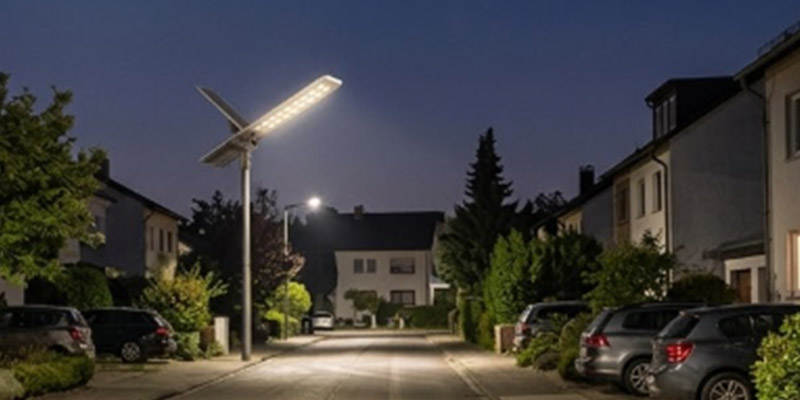
Tailored to the living environment of community walkways, HOAN’s integrated solar street lights comprehensively optimize the community lighting system across dimensions such as installation and renovation, operating costs, resident experience, safety protection, and smart management, offering practicality that far exceeds that of traditional grid-connected street lights.
Community walkways are divided into various types, including narrow courtyard paths, central thoroughfares, scenic walkways, and parking lot access paths. Lighting requirements, foot traffic, and environmental conditions vary greatly across these scenarios, necessitating targeted product selection to balance effectiveness, cost, and practicality.
The entire HOAN line of community solar street lights has passed CE and RoHS international certifications. We support customization of brightness, operating duration, and logo appearance, and can provide complete construction plans and acceptance documentation, making them suitable for various community infrastructure projects both domestically and internationally.
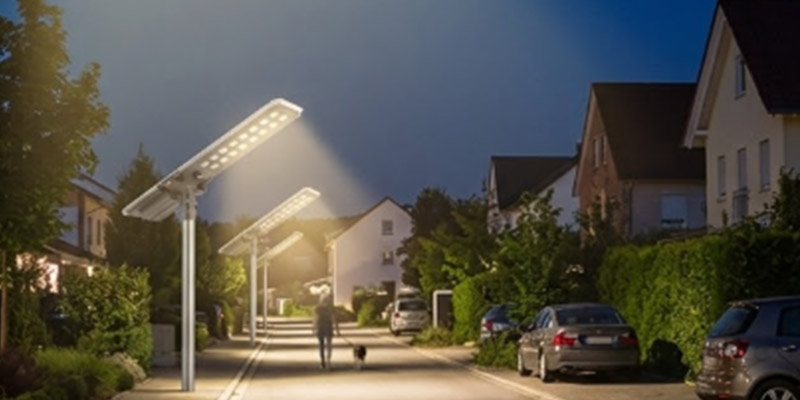
Compared to traditional grid-connected street lights, solar street lights offer comprehensive advantages in community settings. In terms of installation, traditional streetlights require excavation for wiring and the construction of power distribution systems, resulting in long construction periods, high costs, and significant disruption to residents; solar streetlights require no wiring or excavation—they are installed simply by erecting the pole—reducing total renovation costs by more than 40%. In terms of operation, traditional streetlights incur ongoing high electricity bills and maintenance costs, representing a massive long-term investment; solar streetlights have zero electricity costs, low failure rates, and require no frequent maintenance, significantly reducing the operational burden on property management. In terms of user experience, traditional streetlights emit harsh, glaring light and cause severe light pollution; HOAN solar streetlights, however, provide soft, directional lighting, resulting in zero complaints from residents. In terms of adaptability, whether in older residential complexes without utility lines or newly built landscaped communities, solar streetlights can be flexibly implemented, making them the optimal solution for upgrading community walkway lighting.
To ensure the effectiveness and long-term stability of community lighting projects, procurement and model selection must be precisely tailored to the specific application: In high-density residential communities, prioritize compact, soft-light, anti-glare pathway lights to avoid light pollution; in rainy southern regions and coastal communities, be sure to select IP65 corrosion-resistant and waterproof models to prevent equipment corrosion and water ingress; for renovations of older residential complexes, lightweight, all-in-one units are the preferred choice to shorten construction time and minimize disruption to residents; for main thoroughfares in large communities, high-power models with motion sensors should be selected to balance lighting effectiveness with energy efficiency and battery life. For overseas community projects, partner directly with HOAN’s source factory to obtain a full set of certification documents and construction drawings, and take advantage of the option to test samples before bulk procurement to mitigate project acceptance risks.
Community walkway lighting is a vital component of community infrastructure and property management services. Traditional grid-powered lighting suffers from multiple shortcomings, including high retrofit costs, cumbersome operation and maintenance, light pollution that disturbs residents, and equipment susceptibility to damage. HOAN’s integrated solar streetlights, with their core advantages—including no wiring and zero electricity costs, soft, glare-free lighting, smart battery life management, all-weather durability, and easy installation—are perfectly suited for walkway lighting upgrades in all scenarios, including new and existing residential complexes, coastal areas with high rainfall, and landscaped communities. They not only reduce long-term operational costs for property management but also enhance residents’ living experience and community safety, making them the leading choice for lightweight, smart lighting upgrades in residential communities today.
To obtain customized lighting selection plans for community walkways, detailed product specifications, real-world renovation case studies, and bulk purchase quotes, visit the HOAN official website at haroadstud.com. You can request free samples, consult with professional engineering advisors one-on-one, and customize a tailored lighting solution for your community.