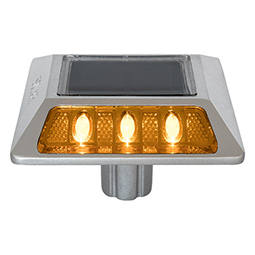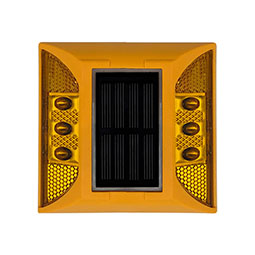
When choosing solar road studs, most people first look at the battery capacity in milliampere-hours, the load-bearing capacity in metric tons, and whether they have an IP68 rating—very few pay attention to the solar panels. Yet when problems arise in a project, they almost always stem from these panels.
Even with the same rated capacity of 4,000 mAh, some spikes can stay lit as usual even after three to five consecutive days of overcast weather, while others dim as early as the second night. Buyers compare the two sets of spec sheets but can’t spot the difference, so they ask why. Most of the time, the answer lies in the solar panel: conversion efficiency, low-light response, and wear resistance. These three factors directly determine how much electricity the entire road stud system can generate in a day.
The solar panels in road studs are not the same as those in rooftop solar power stations. They are laid flat on the road surface without any tilt, cover an area no larger than the palm of your hand, and are constantly exposed to dust, mud, and water, as well as being scraped by tires. Under these conditions, even a slight deficiency in the panel’s quality leads to a significant drop in the system’s overall performance. Below, we’ll explain this chain of cause and effect in detail.
During the day, the solar panel converts light into electricity to charge the lithium battery; at night, the battery discharges to power the LEDs. In this process, the battery determines “the maximum storage capacity,” while the solar panel determines “the daily energy yield.”
Roof-mounted panels can be adjusted to track the sun, but track nails cannot. Buried in the road surface, they can only passively receive oblique sunlight; their usable area is limited by the size of the housing, and their operating temperature is significantly higher than the ambient temperature.
No matter how large the battery is, if the panels cannot generate enough electricity, the lights will still not reach full brightness at night. A high-capacity battery cannot compensate for low-efficiency solar panels; it merely postpones the shortfall by a few days.
When sunlight is abundant, high-efficiency panels can fully charge the battery in a few hours, while low-efficiency panels can still charge it to 70–80 percent. At this stage, the brightness of the two road studs is roughly the same, and the difference is almost imperceptible on-site; many people confirm their satisfaction with the product at this stage.
On cloudy days, the panels rely on scattered light, which has low energy density. High-efficiency monocrystalline silicon panels can still maintain a usable level of power generation, while low-efficiency polycrystalline silicon panels see a drastic drop in output. If the panels do not generate enough electricity to cover that night’s consumption, the battery level will drop day by day; after several consecutive days of cloudy or rainy weather, the road studs will stop lighting up entirely.
In summer, asphalt road surfaces can reach 60–70 degrees. All photovoltaic panels experience efficiency losses at high temperatures; the difference lies in the extent of that loss. Monocrystalline silicon panels optimized for temperature show relatively mild degradation, while cheaper panels used in desert and tropical projects suffer much steeper declines, generating almost no power during the hottest hours of the day.
Panel surfaces are exposed to gravel and tire contact daily. Once the surface is scratched, light transmittance drops; a layer of mud further reduces the amount of light entering. With poor encapsulation, the panel and its casing may delaminate or separate after a few months, causing efficiency to plummet rather than gradually decline.
If the panel is large and the battery is small, excess electricity is wasted; if the panel is small and the battery is large, the battery will not be fully charged over the long term. A reasonable configuration involves calculating a balance point based on local sunlight conditions, ensuring that the daily electricity generated just covers nighttime consumption while leaving a margin. Simply piling up battery capacity means spending money on features that won’t be utilized.
Brand Tip: HOAN uses high-efficiency monocrystalline silicon panels in its HA‑RS‑143N, HA‑RS‑150, and HA‑RS‑D3 models, striking a balance between conversion efficiency, low-light response, and wear resistance.
High conversion efficiency, more stable output under low-light and diffuse light conditions, and relatively mild high-temperature degradation. While the cost is slightly higher, for projects in areas with year-round fog, heavy rainfall, high latitudes, or high desert temperatures, this cost difference is typically offset by reduced rework.
It has a lower unit price and performs acceptably under direct strong sunlight. However, output drops significantly on cloudy or foggy days. It is more suitable for temporary road sections with ample year-round sunlight and low traffic volume; however, it is important to understand that this involves a certain degree of risk.
Specification sheets may list high milliampere ratings for the cells, yet the panels are actually equipped with lower-grade polycrystalline silicon. Buyers who focus solely on the cell specifications may assume the configuration is good, only to find the system fails in rainy regions. Such misrepresentations are completely invisible in quotations.
For highways, airport aprons, mountainous areas, and foggy coastal roads, prioritize wear-resistant monocrystalline silicon solutions. For temporary projects with intense sunlight and short project cycles, polycrystalline silicon can be considered provided you are fully informed. HOAN’s three series come standard with Grade A monocrystalline silicon panels.
The HA‑RS‑143N, HA‑RS‑150, and HA‑RS‑D3 come standard with Grade A monocrystalline silicon panels, offering a balance between conversion efficiency, low-light performance, and high-temperature stability. They are suitable for projects in foggy, rainy, and tropical high-temperature environments.
The encapsulation features an abrasion-resistant treatment that resists scratches from gravel and road surface wear, helping to slow efficiency degradation on heavily trafficked roads. The panels and cells are designed to be system-matched, avoiding waste caused by “oversized cells that cannot be fully charged.”
Irradiance-simulated charging tests are conducted before each batch is shipped. Customers may also take samples for on-site verification in their local area and make a decision after testing. Export documentation and bidding materials are provided according to the model, and model selection recommendations for different climate zones can be provided separately.
Review the checklist: First, determine whether the local climate is characterized by frequent rain, fog, or strong sunlight and high temperatures; clarify whether a monocrystalline or polycrystalline solution is required; verify the panel’s abrasion-resistant encapsulation; do not judge solely based on cell capacity—consider the compatibility between the panel and the cells; avoid installing in areas with permanent shading; and conduct on-site testing of samples under local weather conditions before placing a bulk order.
The efficiency of a solar panel is not just a nice-looking laboratory figure—it directly determines how much electricity this set of road studs can generate each day. Under real-world conditions such as rain, heavy fog, and high temperatures, this difference is amplified. Larger cells cannot compensate for low-efficiency panels; matching panels to the climate during selection is far more cost-effective than adding additional equipment later.
If you’re selecting products for road projects in rainy, foggy, or high-temperature regions, visit haroadstud.com to explore the HOAN monocrystalline silicon series and request samples. You can also send us your project’s climate conditions, and we’ll provide configuration recommendations and a quote.